|
Article
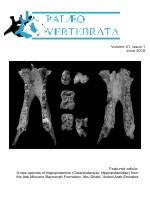
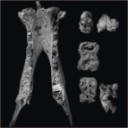
A new species of hippopotamine (Cetartiodactyla, Hippopotamidae) from the late Miocene Baynunah Formation, Abu Dhabi, United Arab Emirates
Published online: 07/04/2017
Keywords:
Arab Peninsula; Hippopotamidae; Hippopotamine event; Systematics
https://doi.org/10.18563/pv.41.1.e2
Cited by: 8
Cite this article:
Jean-Renaud Boisserie, Mathieu Schuster, Mark J. Beech, Andrew Hill and Faysal Bibi, 2017. A new species of hippopotamine (Cetartiodactyla, Hippopotamidae) from the late Miocene Baynunah Formation, Abu Dhabi, United Arab Emirates. PalaeoVertebrata 40 (1)-e2. doi: 10.18563/pv.41.1.e2
Export citation
Abstract
The discovery of new hippopotamid material from the late Miocene Baynunah Formation (Abu Dhabi, United Arab Emirates) has prompted the revision of the existing material of this as yet unnamed fossil taxon. The Baynunah hippopotamid appears to be distinct from all other contemporary and later species in having a relatively more elongate symphysis, a feature similar to the earlier (and more primitive) Kenyapotamus. Yet, the Baynunah hippopotamid presents a dentition typical of the Hippopotaminae. It is therefore a distinct species attributed to the later subfamily, described and named in this contribution. This species provides further evidence for a ca. 8 Ma evolutionary event (termed “Hippopotamine Event”) that initiated the spread and ecological significance of the Hippopotaminae into wet habitats across Africa and Eurasia. The morphological affinities of the new species from Abu Dhabi suggest that the Arabian Peninsula was not a dispersal route from Africa toward southern Asia for the Hippopotamidae at ca. 7.5 Ma to 6.5 Ma.
Published in Vol 41-1 (2018)
Cited by:
Faysal Bibi, Ferhat Kaya and Sara Varela (2022). Paleoecology and Paleobiogeography of the Baynunah Fauna. In: Sands of Time. https://doi.org/10.1007/978-3-030-83883-6_19
Mark J. Beech, Brian Kraatz and Faysal Bibi (2022). The History of Paleontological Investigation in Western Abu Dhabi Emirate. In: Sands of Time. https://doi.org/10.1007/978-3-030-83883-6_1
William J. Sanders (2022). Proboscidea from the Baynunah Formation. In: Sands of Time. https://doi.org/10.1007/978-3-030-83883-6_10
Jean-Renaud Boisserie and Faysal Bibi (2022). Hippopotamidae from the Baynunah Formation. In: Sands of Time. https://doi.org/10.1007/978-3-030-83883-6_15
Faysal Bibi, Mark J. Beech, Andrew Hill and Brian Kraatz (2022). Fossil Localities of the Baynunah Formation. In: Sands of Time. https://doi.org/10.1007/978-3-030-83883-6_2
R. Martino, L. Rook, O. Mateus and L. Pandolfi (2024). The Late Miocene hippopotamid,Archaeopotamus pantanelliinov. comb., from the Casino Basin (Tuscany, Italy): paleobiogeographic implications. Historical Biology. https://doi.org/10.1080/08912963.2023.2194912
Monika Markowska, Hubert B. Vonhof, Huw S. Groucutt, Paul S. Breeze, Nick Drake, Mathew Stewart, Richard Albert, Eric Andrieux, James Blinkhorn, Nicole Boivin, Alexander Budsky, Richard Clark-Wilson, Dominik Fleitmann, Axel Gerdes, Ashley N. Martin, Alfredo Martínez-García, Samuel L. Nicholson, Gilbert J. Price, Eleanor M. L. Scerri, Denis Scholz, Nils Vanwezer, Michael Weber, Abdullah M. Alsharekh, Abdul Aziz Al Omari, Yahya S. A. Al-Mufarreh, Faisal Al-Jibreen, Mesfer Alqahtani, Mahmoud Al-Shanti, Iyad Zalmout, Michael D. Petraglia and Gerald H. Haug (2025). Recurrent humid phases in Arabia over the past 8 million years. Nature. https://doi.org/10.1038/s41586-025-08859-6
Mohammed H. Al Riaydh and Thomas Lehmann (2026). As-Sahabi at the crossroads: Current palaeontological knowledge and future perspectives. Journal of African Earth Sciences. https://doi.org/10.1016/j.jafrearsci.2025.105871
|
PDF
S.I. Data
|