|
A late Eocene palaeoamasiine embrithopod (Mammalia, Afrotheria) from the Adriatic realm (Island of Rab, Croatia)
Published online: 14/12/2023
Keywords:
Balkanatolia; Grande Coupure; Great Adria; Paleobiogeography; Systematics
https://doi.org/10.18563/pv.47.1.e1
Abstract
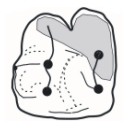
A cheek tooth recently unearthed in the Lopar Sandstone unit, of late Eocene age, in the northern part of Rab Island, Croatia, is one of the very few Eocene mammalian remains found in the Adriatic area. Thorough comparison of this tooth with those of Old-World Palaeogene mammalian orders suggests that it is a M3 belonging to an embrithopod afrothere. The specimen is referred to as Palaeoamasia sp. This genus was formerly known only in Eocene deposits of Anatolia but with close relatives in Romania among Palaeoamasiinae. The geographical distribution of this subfamily perfectly matches the recently-named Balkanatolian landmass, which experienced in-situ evolution of endemic mammals prior to the Grande Coupure event that occurred around the Eocene–Oligocene transition. This last event is characterised by massive Asian immigration in Western Europe and the supposed extinction of many endemic Central and Western European mammals, including Palaeoamasiinae.
PV article infos
Published in 47-1 (2024)
|
PDF
|
|
A new species of hippopotamine (Cetartiodactyla, Hippopotamidae) from the late Miocene Baynunah Formation, Abu Dhabi, United Arab Emirates
Published online: 07/04/2017
Keywords:
Arab Peninsula; Hippopotamidae; Hippopotamine event; Systematics
https://doi.org/10.18563/pv.41.1.e2
Abstract
The discovery of new hippopotamid material from the late Miocene Baynunah Formation (Abu Dhabi, United Arab Emirates) has prompted the revision of the existing material of this as yet unnamed fossil taxon. The Baynunah hippopotamid appears to be distinct from all other contemporary and later species in having a relatively more elongate symphysis, a feature similar to the earlier (and more primitive) Kenyapotamus. Yet, the Baynunah hippopotamid presents a dentition typical of the Hippopotaminae. It is therefore a distinct species attributed to the later subfamily, described and named in this contribution. This species provides further evidence for a ca. 8 Ma evolutionary event (termed “Hippopotamine Event”) that initiated the spread and ecological significance of the Hippopotaminae into wet habitats across Africa and Eurasia. The morphological affinities of the new species from Abu Dhabi suggest that the Arabian Peninsula was not a dispersal route from Africa toward southern Asia for the Hippopotamidae at ca. 7.5 Ma to 6.5 Ma.
PV article infos
Published in Vol 41-1 (2018)
|
PDF
S.I. Data
|
|
Rodent paleocommunities from the Oligocene of Ulantatal (Inner Mongolia, China)
Published online: 10/06/2014
Keywords:
late Paleogene; Mammalia; Mongolian Plateau; Rodentia; Systematics
https://doi.org/10.18563/pv.38.1.e3
Abstract
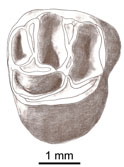
The Oligocene deposits of the Ulantatal area in Inner Mongolia (China) contain among the richest mammalian faunas from Asia. To date, only some parts of the rodent faunas have been described. Here, we propose to review the rodent faunal lists for each site, including the description of a few new rodent specimens. We describe three additional rodent species: the Cylindrodontidae Anomoemys lohiculus, the Eomyidae Asianeomys sp., and the Dipodidae Litodonomys huangheensis. This study allows us to constrain the stratigraphic range of Anomoemys lohiculus, which ranged from the late Early Oligocene to the early Late Oligocene in this area. Asianeomys sp. and Litodonomys huangheensis are dated from the latest Oligocene. These Oligocene deposits consist now of more than 70 species of mammals if we include the fauna from Kekeamu. This latter corresponds to the basal part of the Ulantatal Formation and could be dated biochronologically from the earliest Oligocene. When compared to the faunas from the Valley of Lakes in Central Mongolia, the Ulantatal faunas present a great majority of rodents, and this difference can be partly explained by sampling and description biases regarding macro-mammals. This study also shows that variations existed between Inner and Central Mongolia, especially regarding the composition of the rodent paleocommunities. However, the assessment of their evolutionary history in this part of Asia with respect to the important climate and environment changes, require further precisions and more material than current data allow.
PV article infos
Published in Vol.38-1 (2014)
|
PDF
|
|
Les rongeurs de Chéry-Chartreuve et Rocourt-Saint-Martin (est du bassin de Paris; Aisne, France). Leur place parmi les faunes de l'Eocène Moyen d'Europe
Published online: 15/12/2012
Keywords:
Biochronology; evolution; Middle Eocene; Paris basin; Rodents; Systematics
https://doi.org/10.18563/pv.37.4-5.167-271
Abstract
This paper is mainly devoted to the systematics of rodents from two middle Eocene (Bartonian) localities: Chéry-Chartreuve and Rocourt-Saint-Martin (Aisne, Eastern Paris Basin). These two localities are stratigraphically located slightly above the Auversian sands. The two faunas, which comprise 11 and 8 taxa, respectively, are very different in their composition. That of Rocourt-Saint-Martin shows strong similarities with that of the geographically very close locality of Grisolles, referred to the MP16 mammalian Reference level. The very distinct fauna of Chéry-Chartreuve includes a new species of Ailuravinae, Ailuravus nov.sp, and some teeth of the theridomyid Protadelomys, which represent archaic elements in the fauna. The most abundant species of the locality represents a new genus of primitive Theridomyidae. The presence of some teeth belonging to a new species of large Remyinae, Remys nov. sp., of Elfomys engesseri HOOKER & WEIDMANN, and a population of small dimensions referred to the genus Estellomys allow a correlation with Les Alleveys (Switzerland), with however some differences that would indicate an older age for Chéry-Chartreuve. Situated at the base of the "Marinesian" from the Bassin de Paris, this fauna is unquestionably different from those referred to the MP16 reference level and could represent an older level for which the macrofauna remains very poorly known. Conversely, the comparison of rodents from La Livinière II with those present in MP16 faunas, especially those of Robiac (Gard), shows a great similarity between both localities. This casts doubts on whether to keep this La Livinière II faunule to define the current MP15 reference level, while the biostratigraphical position of Pontils 26 (Spain), previously referred to this level, is reconsidered. Chery Chartreuse could be a good candidate for a new definition of the MP15 reference level.
PV article infos
Published in Vol. 37, Fasc. 4-5 (2012)
|
PDF
|
|
Révision systématique des Anchilophini (Palaeotheriidae, Perissodactyla, Mammalia).
Published online: 15/10/2012
Keywords:
Anchilophus; Eocene; new genus; new species; Palaeotheriidae; Paranchilophus; Perissodactyla; Systematics
https://doi.org/10.18563/pv.37.1-3.1-165
Abstract
The knowledge of the Anchilophini has been lately renewed by the discovery of a rather large amount of new material still largely unpublished. This new material offers the opportunity of a systematic revision of this tribe gathering those of European Eocene Equoidea which bear no mesostyle on upper check teeth and display a heavy trend to the molarization of premolars.
A cladistic analysis has made out two genera, Anchilophus (Paranchilophus included as a subgenus), characterized by a marked lophodonty and the transverse narrowness of the cheek teeth, a rather high hypsodonty, the frequent occurrence of "crochets" and "anticrochets" on the superior ones, and a rather weak molarization of the premolars, opposite to Metanchilophus n. gen. whose cheek teeth are more transversally elongated, less high, less lophodont, with cusps better distinct, enamel thicker and premolars more molarized on the whole.
Three species of Anchilophus are recognized, A. desmaresti, type species of the genus, A. (Paranchilophus) remyi and A. (Paranchilophus) jeanteli n. sp.
The genus Metanchilophus is more diversified with the species dumasi, radegondensis, gaudini (whose a new sub-species M. g. fontensis is defined), depereli, castrensis n. sp. and chaubeti n. sp.
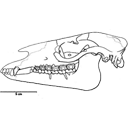
The skull anatomy has been moreover described with several taxa; it brings to light (for all that one can generalize) that Anchilophini were light animals with a slender and elongated snout, a thin zygomatic arch, a rather developed encephalon with an advanced gyrencephaly.
The structure of the nasal opening together with the occurrence of epitympanic sinuses and the molarizing process of the premolars corroborate the attribution of this tribe to the family PalaeotheIiidae.
PV article infos
Published in Vol. 37, Fasc. 1-3 (2012)
|
PDF
|

|
Revision of the family Cephalomyidae (Rodentia, Caviomorpha) and new cephalomyids from the early Miocene of Patagonia.
Published online: 30/07/2001
Keywords:
Cephalomyidae; Lower Miocene; Patagonia; Rodentia; Soriamys; Systematics
https://doi.org/10.18563/pv.30.1-2.51-88
Abstract
A new genus of hystricognath rodent with two new species, Soriamys gaimanensis and Soriamys ganganensis, from the Colhuehuapian Age (Early Miocene), Sarmiento Formation, of Patagonia is described. The first species comes from the south barranca of the valley of Rio Chubut, near Gaiman locality (Chubut Province). It is known through a great number of dental remains in different stages of wear. The teeth are protohypsodont, with cement in the principal valleys. P4 are simpler, more oval inoutline and without a differentiated hypocone-hypoflexus. Upper molars are pentalophodont in early stages of wear and become bilobated in middle and advanced stages; M3 have a temporary third posterior lobe due to the maintenance of the braquiflexus on the posterior wall of the tooth. Lower teeth have a completely asymrnetrical pattern in relation to the uppers. The molars are trilophodont, with only one complex crest in the trigonid composed of the fusion of the anterolophid and mesolophid. The dp4 have a derived pentalophodont pattern due to the loss or fusion of the mesolophid and the development of an accessory transverse crest between the anterolophid and metalophid. The second species is known through a complete skull and jaw and other skull fragments with the dentition, proceeding from Pampa de Gan Gan, Chubut province. Respect to the first species, the teeth are higher crowned, with an earlier occlusal simplification and a third posterior lobe of M3 more developed and persistent. The skull and jaws show many chinchilloid characters, such as jugal bone with an ascending process, concave palate, very prominent dorsal shelf of the masseteric fossa, nasolachrymal duct opened laterally on the maxillary and very developed lateral mandibular fossa. Moreover, Soriamys is closely related to Cephalomys by sharing a similar asymmetric dental pattern and other dental and mandibular characters. These two genera constitute a natural group, the Cephalomyidae, with peculiar dental characters, like the asymmetric pattem of the upper and lower teeth; Cephalomyopsis, and probably Litadontomys, can be considered part of this group. Scotamys and Perimys constitute a distinct lineage (the Neopiblemidae or Perimyidae), more closely related to the chinchillids. Many characters shared by cephalomyids, eocardiids and caviids suggest a closer affinity between the Chinchilloidea and the Cavioiidea as a whole. Abrocoma shows also an asymmetric dental pattern and other chinchilloid features that suggest some degree of relationship with the cephalomyids, still not well determined.
PV article infos
Published in Vol. 30, Fasc. 1-2 (2001)
|
PDF
|

|
Rythme et modalités de l'évolution chez les rongeurs à la fin de l'Oligocène-leurs relations avec les changements de l'environnement.
Published online: 15/12/2000
Keywords:
Environment; evolution; Oligocene; Rodents; Systematics
https://doi.org/10.18563/pv.29.2-4.83-360
Abstract
The analysis of oxygene isotope variations as well as paleobotanical data suggest that the Oligocene/Miocene boundary corresponds to a transitional period marked by floristical and climatic variations. During this period, the pyreneo-alpine tectonics has contribued to modify the geography and western Europe landscapes. Faunal changes (appearances, extinctions, migrations) are observed in different mammalian groups, notably in the rodents. A study of the evolutionary trends and patterns in paleogene rodents is involved for the period ranging from level MP 28 of the Late Oligocene to the Early Miocene, including the Oligo-Miocene boundary.
The Rodents fauna from the sites of Venelles (Bouches-du-Rhône District, France) and Thezels (Lot, France), previously mentionned in litterature, have been studied. The first description of the Eomyidae of La Milloque (MP 29) has been completed. These faunas are compared to those from various localities dating from the considered period. In La Milloque, a new representative of the Eomys species is described next to a form close to Rhodanomys hugueneyae ENGESSER, 1987. It is the Eomys milloquensis nov. sp., the likely descendant of Eomys quercyi COMTE & VIANEY-LIAUD, 1987. Two new species are also described in Thezels: Eucricetodon thezelensis nov. sp., resulting from a likely and local evolution of Eucricetodon praecursor (SCHAUB, 1925) from La Milloque, which, in the same geographic area, could be at the origin of Eucricetodon hesperius ENGESSER, 1985 from Paulhiac. Plesiosminthus admyarion nov. sp., quite distinct from Plesiosminthus schaubi VIRET, 1926, which announces Plesiosminthus myarion SCHAUB 1930. Venelles 'Plesiosminthus schaubi population is considered as a sub-species, named Plesiosminthus schaubi meridionalis nov. subsp. New phylogenetic patterns are proposed. Among the Eomyidae, a quantification of various features of the M1-2/ crown (hypsodonty, degree of abrasion, occlusal angle, state of development of the I and V anticlines), and a comparison with the occlusal diagram of the other teeth among various other populations allows a more efficient separation of Eomys and Rhodanomys genera. In Western Europe, and within this period, it finally does not seem possible to gradually connect the genus Eomys to the genus Rhodanomys. The evolution of the Eomys quercyi - milloquensis lineage seems to underline a similar evolution to that which may have led from the Eomys to the Rhodanomys form. The latter which appears totally accomplished at level MP 29 of the Oligocene is considered as an immigrant. If we compare the most representative species of the Venelles, Thezels, and Coderet sites, (i.e. Rhodanomys, Eucricetodon, Adelomyarion, Peridyromys, Plesíosminthus), it becomes impossible to confirm their biochronological separation. The noticeable differences between the populations may be interpreted as geographical variations. An explanation to these variations, and to fauna's evolution during the Late Oligocene and Early Miocene can be found in the environmental modifications, supported by isotopic, paleobotanical and sedimentologic analysis. A tentative reconstruction of the environments is attempted by the cenogram method. The analysis of the fluctuations of fauna's diversity shows variations which may be correlated to a drop in temperature at MP 29, during the Late Oligocene, followed by an increase in temperature along with an aridity phenomenom, during the basal Miocene (MN O).The confrontation of various methods give the opportunity of reconstituting and comparing the evolution of the environment of three sequences of sites chosen from different regions. Ecological affinities of various rodents' species are being examined. It is possible to consider that the integration of all the conclusions resulting from this study should lead to an explanation to the evolution of rodents for the period around the Oligocene-Miocene boundary. The site of Coderet- level 3- would be posterior to the latter, at the beginnig of the Miocene, and would mark the level MN 0 of the Aquitanian.
PV article infos
Published in Vol. 29, Fasc. 2-4 (2000)
|
PDF
|

|
The evolution of the molar pattern of the Erethizontidae (Rodentia,Hystricognathi) and the validity of Parasteiromys Ameghino, 1904.
Published online: 15/06/1999
Keywords:
Argentina; Erethizontidae; Hystricognathi; Miocene; Molar evolution; Porcupines; Rodentia; Systematics
https://doi.org/10.18563/pv.28.1.53-73
Abstract
The genus Parasteiromys AMEGHINO, 1904 is revalidated, and P. friantae sp. nov. (Hystricognathi, Erethizontidae) from Colhuehuapian (early Miocene) sediments of the southern cliff of Colhue-Huapi Lake (Province of Chubut, Argentina), is described. The molar morphology of these taxa and of living porcupines adds new elements to understand the dental evolution of the Erethizontidae, and to propose the hypothetical ancestral molar pattern for this family. This pattern does not correspond to any of the morphologies traditionally proposed as ancestral for South American hystricognathous rodents. The proposed pattern is characterized by a metaloph disconnected from the posteroloph and oriented towards the hypocone, and the third loph incompletely developed with the lingual portion homologous to the mesolophule of Baluchimyinae (Chapattimyidae) from the Miocene of Pakistan. The inferred steps of the molar evolution of erethizontids towards the pentalophodont condition, considered derived for the family, are illustrated. This study strengthens the hypothesis placing erethizontids in a basal position among rodents of the suborder Hystricognathi.
PV article infos
Published in Vol. 28, Fasc. 1 (1999)
|
PDF
|

|
Nouvelles données sur les mammifères du Thanétien et de l'Yprésien du bassin d'Ouarzazate (Maroc) et leur contexte stratigraphique.
Published online: 15/12/1998
Keywords:
early Paleogene; magnetostratigraphy; Mammals; Morocco; North Africa; Ouarzazatz basin; Systematics
https://doi.org/10.18563/pv.27.3-4.155-202
Abstract
New faunal and stratigraphical data on the vertebrates localities from the early Paleogene of the Ouarzazate Basin (Adrar Mgorn 1, Adrar Mgorn 1 bis et N'Tagourt 2), Morocco, are presented. A magnetostratigraphical study, the first for such early Paleogene Arabo-African mammal localities, and the discovery of probable remains of the nannofossil Discoaster support the Thanetian age of the Adrar Mgorn 1 site. The magnetostratigraphy suggests a slightly later age than was thought for the Paleogene formations of the local series of Tinerhir and for the vertebrate localities: late or latest Thanetian for Adrar Mgorn 1 and Adrar Mgorn 1 bis, middle Ypresian for N'Tagourt 2. It also indicates a lower position of the KT boundary in the series. Two tons of matrix recovered in the vertebrate sites have vielded new data on the micromammals. A damaged lower molar from N'Tagourt 2 is referable to Khamsaconus bulbosus and supports the proboscidean affinities of this species and especially possible relationships with bunolophodont taxa such as elephantiforms. A lower molar from Adrar Mgorn 1 bis belongs to a new form which can be identified as a plesiadapiform or an euprimate close to Altiatlasius koulchii though significantly larger. A new material from Adrar Mgorn 1 illustrates a new dilambdodont adapisoriculid species which is referable to Garatherium : ?Garatherium todrae n. sp. Another species referred to Garatherium is known in the locality (?Garatherium n. sp.). Garatherium is a new lineage from the Ouarzazate basin which crosses the Paleocene-Eocene boundary together with Palaeoryctes, Didelphodontinae gen. and sp. 2, Todralestes, and Afrodon, and it is the first Paleocene-Eocene lineage identified outside of this basin (Garatheríum is based on a species from El Kohol, Algeria). Among the Paleocene-Eocene lineages from the Ouarzazate basin, it should be also mentioned a new possible carnassial form (carnivoran or creodont; Adrar Mgorn 1), and an upper molar of Cimolestes cf. incisus (Adrar Mgorn 1 bis). The upper molar THR 168 previously reported as from an indeterminate didelphodontine is here identified as the M1/ of Afrodon chleuhi. The micromammal faunas from the Ouarzazate basin are positioned in the global chronological framework of the mammal localities from the Paleogene of the Arabo-African domain.
PV article infos
Published in Vol. 27, Fasc. 3-4 (1998)
|
PDF
|

|
Le genre Leptolophus (Perissodactyla, Mammalia): morphologie et histologie dentaires, anatomie cranienne, implications fonctionnelles.
Published online: 15/09/1998
Keywords:
dental histology; Eocene; functional anatomy; Palaeotheriidae; skull anatomy; Southern France; Systematics
https://doi.org/10.18563/pv.27.1-2.45-108
Abstract
A strong lophodonty, an extreme heterodonty, some hypsodonty and regular overlayings of coronal cement are prominent features of the genus Leptolophus (Palaeotheriinae = Palaeotheriidae s.s.). The histological pattern of the teeth unusually joins type II enamel prisms, characteristic of advanced ungulates, together with archaic features, such as an almost complete lack of Hunter-Schreger zonation and a weak expanse of peritubular dentine. The skull is narrow and slender, with an elongated ante-orbital facial region, a moderately notched nasal aperture, a rather elongated post-canine diastem, parallel zygornatic arches and a fairly dorsally located squamoso-mandibular joint.The functional analysis brings to light "ectolophodont" masticatory cycles with two phases, in which maximum power was applied, contrary to equíds, on hindmost teeth; likewise, skull accomodations to increasing height of the teeth are quite different. This study leads to the assumption that Leptolophus may have been light mammals, living in rather open surroundings, browsing on herbaceous plants or leaves cropped close to the ground. Moreover, it appears that it could have been some inadequacy of dental structures to the dietary, which leaded to quick wear of the teeth and to many enamel notches, but had been somewhat balanced by the early increase of hypsodonty, not induced in such a case by a biotop deterioration (as it will happen at the end of the Eocene). This ínadaptation might account for the short duration of the genus Leptolophus, whose the 3 species, L. stehlini, L. nouletí and L. magnus n. sp. are indeed confined in the level MP 16. Its geographical spreading (as far as known, South of western Europe) and the morphological pattern of its dentition suggest that this genus would have been related to early upper Eocene endemic spanish forms.
PV article infos
Published in Vol. 27, Fasc. 1-2 (1998)
|
PDF
|

|
Une nouvelle espèce de Steneosaurus (Thalattosuchia, Teleosauridae) dans le Callovien du Poitou (France) et la systématique des Steneosaurus longirostres du Jurassique moyen d'Europe Occidentale.
Published online: 15/09/1998
Keywords:
middle Jurassic; nov. sp.; phylogenetic relationships; skulls; Steneosaurus pictaviensis; Systematics; thalattosuchian crocodile
https://doi.org/10.18563/pv.27.1-2.19-44
Abstract
The study of all the available skulls allows us to review the systematic relationships of the longirostrine Steneosaurus from the Middle Jurassic of western Europe. Up to now, Aalenian and Bajocian deposits have not yielded any significant Steneosaurus remain. In the Bathonian, the only valid longirostrine species, S. megistorhynchus, is known in the Britain-Normandy Basin, the Poitou and the Lorraine. In the Callovian, most of the longirostrine Steneosaurus remains can be attributed to the species S. leedsi. Nevertheless, some remains from the Middle Callovian of Poitou (France) show important differences with S. leedsi. A new Steneosaurus species, only known in Poitou, is created and named S. pictaviensis. The specific characters are carried by the skull (preorbital pit well marked, orbit and ptetygoid fossae shapes), by the mandible (symphysis shape) and by the teeth (ornamentation). S. megistorhynchus is probably situated near the stem of the Callovian species but remains from the Bathonian and Lower Callovian are very scarce and it is very difficult to precise the phylogenetic relationships between the longirostrine species of the Middle Jurassic.
PV article infos
Published in Vol. 27, Fasc. 1-2 (1998)
|
PDF
|

|
New murids and gerbillids (Rodentia, Mammalia) from Pliocene Siwalik sediments of India.
Published online: 15/12/1997
Keywords:
Dental morphology; evolution; new species of murids and gerbillids; phylogenetic relationships; Systematics
https://doi.org/10.18563/pv.26.1-4.129-165
Abstract
Murids and gerbillids (Rodentia, Mammalia) recovered from four Upper Siwalik localities; Moginand (around 3.5-4.5 m.y.), Kanthro (around 2.5 m.y.), Ghaggar (around 2 m.y.) and Nadah (around 1.8-2 m.y.) are described herein. A comparison of Mus linnaeusi sp. nov. reveals its close relationship towards the house mouse Mus musculus. In contradiction to earlier proposals that Golunda migrated to the Indian subcontinent from Africa sometime during Late Pliocene, it is suggested here that Golunda (in the form of Golunda tatroticus sp. nov.) evolved from Parapelomys robertsí of Late Miocene deposits of Siwaliks. Golunda tatroticus sp. nov. exhibits a progressive relationship to the extant Indian Bush Rat Golunda ellioti through Golunda kelleri and Golunda sp. Tatera pinjoricus sp. nov. is considered here to be a link between the extinct Abudhabia kabulense and the extant Tatera indica.
PV article infos
Published in Vol. 26, Fasc. 1-4 (1997)
|
PDF
|

|
Middle Eocene rodents from the Subathu group, Northwest Himalya.
Published online: 15/12/1997
Keywords:
Chapattimyidae; Eocene; evolution; India; Rodentia; Subathu group; Systematics
https://doi.org/10.18563/pv.26.1-4.83-128
Abstract
Extensive collecting in previously known and new Middle Eocene rodent localities in the Subathu Group of the Rajauri and Reasi districts, Jammu and Kashmir (northwest Himalaya, India) has yielded over 500 isolated cheek teeth, numerous incisors and cheek tooth fragments, and two mandibular fragments with M/1-M/3. An analysis of this additional material and a restudy of that reported earlier from the Metka (Rajauri) area has revealed the presence of diverse Middle Eocene ctenodactyloid rodents in India. The assemblage comprises six genera and twelve species, viz.., Bírbalomys woodi, B. ibrahimshahi, B. sondaari, Basalomys vandermeuleni, B. ijlsti, B. lavocati, Chapattimys wilsoni, C. debruijni, Gumbatomys asifi, cf. Advenimus bohlini, cf. Petrokoslovia sp. indet. 1 and cf. Petrokoslovia sp. indet. 2. Most species of this assemblage are endemic to the Indian subcontinent and are referred to the Family Chapattimyidae. However, at least three taxa, viz.., cf. Advenimus bohlini, cf. Petrokoslovia sp.indet. 1 and cf. Pezrokoslovia sp. indet. 2 show close affinities with their Central and Eastern Asiatic contemporaries and are attributed to the Family Yuomyidae. The dentitions of most of the Middle Eocene rodents from India are described here in better detail thus providing more precise characterization than was available earlier. The taxonomie status of Basalomys, formerly a subgenus of Birbalomys has been raised to that of a genus. Basalomys vandermeuleni is here designated as the type species of Basalomys in place of B. ijlsti. The rodent assemblage from the Subathu Group is specifically similar to that from the coeval Kuldana Formation of Pakistan. The absence of Birbalomys ibrahimshahi and cf. Advenimus bohlini in Pakistan is related to sampling bias. The identifications of the Early Eocene rodents from Barbara Banda, Pakistan have been reexamined and the familial assignments of some of the Early and Middle Eocene rodents from Central and Eastern Asia have been discussed and reviewed in the light of recent discovery of early rodents in Mongolia.
PV article infos
Published in Vol. 26, Fasc. 1-4 (1997)
|
PDF
|

|
La morphologie dentaire des Thalattosuchia (Crocodylia, Mesosuchia).
Published online: 15/12/1997
Keywords:
Dental morphology; Dental types; feeding habits.; Jurassic; Metriorhynchidae; Systematics; Teleosauridae; Thalattosuchia
https://doi.org/10.18563/pv.26.1-4.35-59
Abstract
The tooth morphology of the Thalattosuchia (marine crocodilians from the Jurassic and the Early Cretaceous) is analysed. The Callovian from Poitou and the Kimmeridgian from Quercy have yielded many remains of Metriorhynchus, Steneosaurus and Machimosaurus. These remains allow us to study the variations of tooth morphology during ontogenic growth, tooth replacement and the location of the teeth. We have defined different tooth types for these genera. In Metriorhynchus, the two tooth types defined do not coincide with the two groups recognized in the Callovian (broad-skulled and narrow-skulled metriorhynchids) but reflect the prey preferences of these forms. In Steneosaurus and Machimosaurus the five tooth types deñned are in agreement with the main taxa known from the Bathonian to the Early Cretaceous. This study allows to precise the function and the prey preference of the Thalattosuchia during the Jurassic and the Early Cretaceous.
PV article infos
Published in Vol. 26, Fasc. 1-4 (1997)
|
PDF
|

|
A new Ardynomys (Rodentia,Cylindrodontidae) from the Eocene of the eastern Gobi Desert, Mongolia.
Published online: 16/12/1996
Keywords:
Ardynomys; Eocene; Mongolia; Rodentia; Systematics
https://doi.org/10.18563/pv.25.2-4.339-348
Abstract
A partial skull of Ardynomys russelli sp. nov. (Rodentia, Cylindrodontidae) is described. This was collected in the late Eocene of Alag Tsab locality in the eastem Gobi Desert, Mongolia. Ardynomys russelli sp. nov. is characterized by small size, brachyodont molars, and retention of P3. It represents the earliest record of the genus Ardynomys MATTHEW & GRANGER, 1925, in Asia.
PV article infos
Published in Vol. 25, Fasc. 2-4 (1996)
|
PDF
|

|
Observations sur l'anatomie crânienne du genre Palaeotherium (Perissodactyla, Mammalia): mise en évidence d'un nouveau sous-genre, Franzenitherium
Published online: 01/12/1992
Keywords:
Palaeotherium; Paléogène; Perissodactyla; skull anatomy; Systematics
https://doi.org/10.18563/pv.21.3-4.203-224
Abstract
The skull remains referred to the genus Palaeotherium are recorded and described. Biometrical tests are made to elucidate intrageneric allometric relationships and to allow comparisons with various other perissodactyls. Apart from the well known shortness of post canine diastems and deepness of the narial opening, the genus is characterized by a great lengthening of the splanchnocranium, owing to a spreading of the post-orbital facial region, by a reduced area of the eye-socket and by the prevalence of the temporal muscle with regard to the masseter; this original shape of the masticatory apparatus needs to be related to the morphology of the jugal teeth and particularly to their asymmetrical semi-hypsodonty.
These animals, whose running ability was evidently poor, appear to have been adapted to rather closed environments, feeding on relatively soft vegetable matter; olfactory sense was likely to play a leading part in interindividual and environmental relationships. Such evolutionary trends might explain the disappearance of most of them, as clirnatic conditions deteriorated at the end of the Eocene, before the "Grande Coupure" which affected mammalian faunas at that time.
Although the present paper is not directly concemed with phylogenetics, it invalidates the supposed ancestor-descendant relationship between P. castrense and P. magnum, and it suggests a possible emergence of the P. medium lineage from a P. siderolithicum stock. Moreover, the structure of the post-orbital facial area allows the erection of a new sub-genus, Franzenitherium, for the species lautricense and duvali.
PV article infos
Published in Vol. 21, Fasc. 3-4 (1992)
|
PDF
|

|
Hexanchiforme nouveau (Neoselachii) du Crétacé inférieur du Sud de la France
Published online: 18/12/1990
Keywords:
Hexanchiformes; New genera; Southern France; Systematics; Valanginian
https://doi.org/10.18563/pv.20.1.33-54
Abstract
The dentition of Welcommia bodeuri nov. gen. nov. sp. from the Valanginian of Southem France is described and reconstructed. Species and genera of Upper Jurassic and Lower Cretaceous Hexanchiformes are reviewed and discussed.
The genus Notidanoides MAISEY, 1986 must be restricted to the single Nusplingen Upper Jurassic specimen, whose attribution to the species muensteri AGASSIZ, 1843 remains doubtful.
The genus Paranotidanus WARD &THIES, 1987 that does not rest on any type-species nor on any precise dental characterization must be rejected.
The genus Eonotidanus PFEIL, 1983, based on a very poorly preserved and heterogeneous type-material must also be rejected.
Teeth from the Lower Cretaceous, with a peculiar morphology, previously assigned to Eonotidanus or to Notidanoides, are to be ranked in the new genus Pachyhexanchus.
PV article infos
Published in Vol. 20, Fasc. 1 (1990)
|
PDF
|

|
Palaecarcharodon orientalis (Sinzow) (Neoselachii : Cretoxyrhinidae), from the Paleocene of maryland, USA.
Published online: 15/09/1989
Keywords:
Maryland; Palaeocarcharodon; Paleocene; Selachian; Systematics; U.S.A.
https://doi.org/10.18563/pv.19.1.1-6
Abstract
Recent collecting of fossil vertebrate remains from the lowermost member of the Aquia Formation (Paleocene), has enabled me to report here for the very fIrst time, the earliest occurrence for the teeth of Palaeocarcharodon in the fossil record of the New World.
This report represents only one species of neoselachian from this locality, the remaining fauna of which will subsequently be described.
PV article infos
Published in Vol. 19, Fasc. 1 (1989)
|
PDF
|

|
Contributions à l'étude du gisement Miocène supérieur de Montredon (Hérault). Les grands mammifères. 7 - Les proboscidiens Deinotheriidae
Published online: 15/11/1988
Keywords:
allometry; Astaracian; Deinotherium; Montredon; Systematics; taphonomy; Vallesian
https://doi.org/10.18563/pv.18.ext.135-175
Abstract
Some complete tooth rows and about one hundred isolated teeth enabled the identification of the deinothere of the Vallesian site Montredon (Hérault) as Deinotherium giganteum KAUP 1829, mainly by comparisons with the likewise Vallesian sample of the type locality Eppelsheim (Rheinhessen, F.R.G.).
Scatterdiagrams of the teeth show the importance of allometry during the phyletic size increase of the European deinotheres.
Some taphonomic problems of the Montredon deinothere are briefly mentioned.
PV article infos
Published in Vol. 18, Ext (1988)
|
PDF
|

|
Contributions à l'étude du gisement Miocène supérieur de Montredon (Hérault). Les grands mammifères. 2 - les carnivores
Published online: 15/11/1988
Keywords:
anatomy; Carnivora; France; Montredon; Systematics; Upper Miocene
https://doi.org/10.18563/pv.18.ext.15-42
Abstract
The locality of Montredon has provided 8 species of camivores, often little documented, that are discribed and depicted. All the remains are fragmentary and generally badly preserved which lowers very much the possible precision of the taxonomic study; this one has however allowed the creation of a new subspecies. The most richlypdocumented forms are an ursid (Indarctos) and a felid (Machairodus). Issuing often from a westem Europe evolution, the carnivores are well inserted between those of the better known faunas of the "Classical Pontian" and of the lower Vallesian and this situation fits also well with their stratigraphic level, that cannot however be more accurately defined with them alone.
PV article infos
Published in Vol. 18, Ext (1988)
|
PDF
|