|
Article
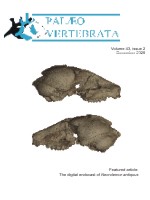
The digital endocast of Necrolemur antiquus
Published online: 24/07/2020
Keywords:
brain evolution; Eocene; Omomyiforms; Primates
https://doi.org/10.18563/pv.43.2.e1
Cited by: 13
Cite this article:
Arianna Harrington, Gabriel Yapuncich and Doug Boyer, 2020. The digital endocast of Necrolemur antiquus. PalaeoVertebrata 43 (2)-e1. doi: 10.18563/pv.43.2.e1
Export citation
Abstract
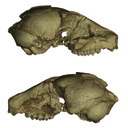
The study of endocasts, or casts of the endocranial space, have played an important role in shaping understanding of mammalian, and particularly primate, brain evolution. Recently, the reconstructions of three-dimensional virtual endocasts from high-resolution computed tomography images have allowed for the visualization and quantification of endocasts in several Paleocene and Eocene primate species. Here we present the virtual endocast of MaPhQ 289 (informally known as the Montauban 9 skull), a specimen of Necrolemur antiquus Filhol 1873, a middle to late Eocene European primate of the family Microchoeridae. The virtual endocast of MaPhQ 289 reveals a lissencephalic surface morphology with expanded temporal poles and minimal overlap of the cerebellum or olfactory bulb by the cerebrum, which closely resembles the morphology of the endocast of its contemporary relative, Microchoerus erinaceus (Primates, Microchoeridae). MaPhQ 289 yields an endocranial volume (ECV) of 2.36 cm3, about 60% smaller than the volume of the most commonly cited ECV of N. antiquus. Thus, the size of the brain of N. antiquus relative to its body size is likely to be smaller than has been reported in previous literature, highlighting the importance of corroborating older ECV estimates with new evidence using 3-D imaging techniques.
Published in 43-2 (2020)
References
Barton, R.A., 2006. Primate brain evolution: integrating comparative, neurophysiological, and ethological data. Evolutionary Anthropology 15, 224-236. https://doi.org/10.1002/evan.20105
Clutton-Brock, T.H., Harvey, P.H., 1980. Primates, brains and ecology. Journal of Zoology 190, 309-323. https://doi.org/10.1111/j.1469-7998.1980.tb01430.x
Copes, L.E., Kimbel, W.H., 2016. Cranial vault thickness in primates: Homo erectus does not have uniquely thick vault bones. Journal of Human Evolution 90, 120-134. https://doi.org/10.1016/j.jhevol.2015.08.008
Dunbar, R.I., 1998. The social brain hypothesis. Evolutionary Anthropology 6, 178-190. https://doi.org/10.1002/(SICI)1520-6505(1998)6:5<178::AID-EVAN5>3.0.CO;2-8
Eliot Smith, G., 1903. On the morphology of the brain in Mammalia, with special reference to that of lemurs, recent and extinct. Transactions of the Linnean Society of London 2nd Ser.: Zoology 8, 319-432. https://doi.org/10.1111/j.1096-3642.1903.tb00497.x
Filhol, H., 1873. On fossil vertebrates found in the lime phosphate deposits of Quercy. Bulletin de la Société philomathique de Paris 10, 85-89.
Gazin, C.L., 1965. An endocranial cast of the Bridger Middle Eocene primate, Smilodectes gracilis. Smithsonian miscellaneous collections.149, 1-14.
Gilbert, C.C., Jungers, W.L., 2017. Comment on relative brain size in early primates and the use of encephalization quotients in primate evolution. Journal of Human Evolution 109, 79-87. https://doi.org/10.1016/j.jhevol.2017.04.007
Godinot, M., 2003. Variabilité morphologique et évolution des Necrolemur (Primates, Omomyiformes) des niveaux-repères MP 17 à MP 20 du sud de la France. Coloquios de Paleontologia. 1, 203-235.
Godinot, M., Dagosto, M., 1983. The astragalus of Necrolemur (Primates, Microchoerinae). Journal of Paleontology 57, 1321-1324.
Gurche, J.A., 1978. Early primate brain evolution. Master’s thesis, University of Kansas.
Gurche, J.A., 1982. Early primate brain evolution. In: Armstrong, E., Falk, D. (Eds.), Primate Brain Evolution: Methods and Concepts. Springer, Boston, MA, pp. 227-246. https://doi.org/10.1007/978-1-4684-4148-2_15
Harrington, A.R., Silcox, M.T., Yapuncich, G.S., Boyer, D.M., Bloch, J.I., 2016. First virtual endocasts of adapiform primates. Journal of Human Evolution 99, 52-78. https://doi.org/10.1016/j.jhevol.2016.06.005
Healy, S.D., Rowe, C., 2007. A critique of comparative studies of brain size. Proceedings of the Royal Society B: Biological Sciences 274, 453-464. https://doi.org/10.1098/rspb.2006.3748
Hürzeler, J., 1948. Zur Stammesgeschichte der Necrolemuriden. Abhandlungen der Schweizerischen Paläontologischen Gesellschaft 66, 1-46.
Eisenberg, J.F., 1981. The Mammalian Radiations: An Analysis of the Trends in Evolution, Adaptation, and Behavior. University of Chicago Press, Chicago.
Jerison, H.J., 1973. Evolution of the Brain and Intelligence. Academic Press, New York. https://doi.org/10.1016/B978-0-12-385250-2.50018-3
Jerison, H.J., 1979. Brain, body and encephalization in early primates. Journal of Human Evolution 8, 615-635. https://doi.org/10.1016/0047-2484(79)90115-5
Kirk, E.C., Daghighi, P., Macrini, T.E., Bhullar, B.A.S., Rowe, T.B., 2014. Cranial anatomy of the Duchesnean primate Rooneyia viejaensis: New insights from high resolution computed tomography. Journal of Human Evolution 74, 82-95. https://doi.org/10.1016/j.jhevol.2014.03.007
Legendre, S., Sigé, B., Astruc, J.G., de Bonis, L., Crochet, J.Y., Denys, C., Godinot, M., Hartenberger, J.L., Lévêque, F., Marandat, B., Mourer-Chauviré, C., Rage, J.C., Remy, J.A., Sudre, J., Vianey-Liaud, M., 1997. Les phosphorites du Quercy: 30 ans de recherche. Bilan et perspectives. Geobios 30, 331-345. https://doi.org/10.1016/S0016-6995(97)80038-1
Long, A., Bloch, J.I., Silcox, M.T., 2015. Quantification of neocortical ratios in stem primates. American Journal of Physical Anthropology 157, 363-373. https://doi.org/10.1002/ajpa.22724
Martin, R.D., 1990. Primate Origins and Evolution: A Phylogenetic Reconstruction. Chapman and Hall, London. https://doi.org/10.1007/978-94-009-0813-0_3
Minwer-Barakat, R., Marigó, J., Moyà-Solà, S., 2015. Necrolemur anadoni, a new species of Microchoerinae (Omomyidae, Primates) from the Middle Eocene of Sant Jaume de Frontanyà (Pyrenees, Northeastern Spain). American Journal of Physical Anthropology 158, 730-744. https://doi.org/10.1002/ajpa.22867
Minwer-Barakat, R., Marigó, J., Femenias-Gual, J., Costeur, L., De Esteban-Trivigno, S., Moyà-Solà, S., 2017. Microchoerus hookeri nov. sp., a new late Eocene European microchoerine (Omomyidae, Primates): new insights on the evolution of the genus Microchoerus. Journal of Human Evolution 102, 42-66. https://doi.org/10.1016/j.jhevol.2016.10.004
Radinsky, L., 1970. The fossil evidence of prosimian brain evolution. In: Noback, C. R., Montagna, W. (Eds.), The Primate Brain, Advances in Primatology, Vol. 1. Appleton Century Crofts, New York, pp. 781-798.
Radinsky, L., 1977. Early primate brains: facts and fiction. Journal of Human Evolution 6, 79-86. https://doi.org/10.1016/S0047-2484(77)80043-2
Ramdarshan, A. Orliac, M.J., 2016. Endocranial morphology of Microchoerus erinaceus (Euprimates, Tarsiiformes) and early evolution of the Euprimates brain. American Journal of Physical Anthropology 159, 5-16. https://doi.org/10.1002/ajpa.22868
Silcox, M.T., Dalmyn, C.K., Bloch, J.I., 2009. Virtual endocast of Ignacius graybullianus (Paromomyidae, Primates) and brain evolution in early primates. Proceedings of the National Academy of Sciences 106, 10987-10992. https://doi.org/10.1073/pnas.0812140106
Silcox, M.T., Benham, A.E., Bloch, J.I., 2010. Endocasts of Microsyops (Microsyopidae, Primates) and the evolution of the brain in primitive primates. Journal of Human Evolution 58, 505-521. https://doi.org/10.1016/j.jhevol.2010.03.008
Simons, E.L., 1961. Notes on Eocene tarsioids and a revision of some Necrolemurinae. Bulletin of the British Museum (Natural History) 5, 43-69.
Simons, E.L., Russell, D.E., 1960. Notes on the cranial anatomy of Necrolemur. Breviora 127, 1-14.
Simpson, G.G., 1944. Tempo and mode in evolution. Columbia University Press, New York.
Stehlin, H.G., 1916. Die Saugetiere des schweizeriscen Eocaens. Siebenter Teil, zweite Hälfte. Abhandlungen der Schweizerischen Paläontologischen Gesellschaft 41, 1299-1552.
Cited by:
Ornella C. Bertrand, Sarah L. Shelley, Thomas E. Williamson, John R. Wible, Stephen G. B. Chester, John J. Flynn, Luke T. Holbrook, Tyler R. Lyson, Jin Meng, Ian M. Miller, Hans P. Püschel, Thierry Smith, Michelle Spaulding, Z. Jack Tseng and Stephen L. Brusatte (2022). Brawn before brains in placental mammals after the end-Cretaceous extinction. Science. https://doi.org/10.1126/science.abl5584
Sergi López‐Torres, Ornella C. Bertrand, Madlen M. Lang, Łucja Fostowicz‐Frelik, Mary T. Silcox, Jin Meng and Lionel Hautier (2023). Cranial endocast of Anagale gobiensis (Anagalidae) and its implications for early brain evolution in Euarchontoglires. Palaeontology. https://doi.org/10.1111/pala.12650
Chelsea L. White, Jonathan I. Bloch, Paul E. Morse and Mary T. Silcox (2023). Virtual endocast of late Paleocene Niptomomys (Microsyopidae, Euarchonta) and early primate brain evolution. Journal of Human Evolution. https://doi.org/10.1016/j.jhevol.2022.103303
Mary T. Silcox and and Sergi López‐Torres (2023). Primate Origins. In: A Companion to Biological Anthropology. https://doi.org/10.1002/9781119828075.ch22
Mary T. Silcox, Ornella C. Bertrand, Arianna R. Harrington, Madlen M. Lang, Gabriela A. San Martin-Flores and Sergi López-Torres (2023). Early Evolution of the Brain in Primates and Their Close Kin. In: Paleoneurology of Amniotes. https://doi.org/10.1007/978-3-031-13983-3_12
Sergi López-Torres, Ornella C Bertrand, Łucja Fostowicz-Frelik, Madlen M Lang, Chris J Law, Gabriela San Martin-Flores, Michael A Schillaci, Mary T Silcox and Deyan Ge (2024). The allometry of brain size in Euarchontoglires: clade-specific patterns and their impact on encephalization quotients. Journal of Mammalogy. https://doi.org/10.1093/jmammal/gyae084
Ornella C. Bertrand, Marina Jiménez Lao, Sarah L. Shelley, John R. Wible, Thomas E. Williamson, Jin Meng and Stephen L. Brusatte (2024). The virtual brain endocast of Trogosus (Mammalia, Tillodontia) and its relevance in understanding the extinction of archaic placental mammals. Journal of Anatomy. https://doi.org/10.1111/joa.13951
E. Christopher Kirk, Christopher J. Campisano, Alan L. Deino, Sebastian Egberts, Addison D. Kemp, Ingrid K. Lundeen and Benjamin Rodwell (2025). A Middle Eocene Haplorhine Frontal Bone From the Tornillo Basin of Texas, and Its Implications for the Phylogenetic Relationships of Rooneyia and Other Paleogene Primates. American Journal of Biological Anthropology. https://doi.org/10.1002/ajpa.70045
Richard F. Kay, E. Christopher Kirk, Sergio F. Vizcaino, M. Susana Bargo, Kari L. Allen, Selby Olson and Paul E. Morse (2025). The Fossil Record of Anthropoid Brain Evolution. American Journal of Biological Anthropology. https://doi.org/10.1002/ajpa.70081
Madlen Maryanna Lang, Mary Teresa Silcox, Łucja Fostowicz‐Frelik, Adam Lis, Sergi López‐Torres, Gabriela San Martin‐Flores and Ornella C. Bertrand (2026). But how does it smell? An investigation of olfactory bulb size among living and fossil primates and other euarchontoglirans. The Anatomical Record. https://doi.org/10.1002/ar.25651
Ornella C. Bertrand, Margot Michaud and E. Christopher Kirk (2026). How the neurosensory system provides clues for the adaptive radiation of mammals. In: Evolution of Nervous Systems. https://doi.org/10.1016/B978-0-443-27380-3.00019-1
Mary T. Silcox (2026). Primate origins and adaptations. In: Evolution of Nervous Systems. https://doi.org/10.1016/B978-0-443-27380-3.00011-7
E. Christopher Kirk, Kari L. Allen, Paul E. Morse, Selby V. Olson and Richard F. Kay (2026). Quantifying primate brain evolution: Evidence from virtual endocasts. In: Evolution of Nervous Systems. https://doi.org/10.1016/B978-0-443-27380-3.00005-1
|
PDF
|