|
Article
L’assemblage mammalien de l’Eocène continental du Complexe de Gour Lazib (Algérie) : structure écologique et implications paléoenvironnementales
Published online: 01/01/1970
Keywords:
Afrique du Nord; Cénogramme; Paléogène; Vertébrés
https://doi.org/10.18563/pv.49.2.e2
References: 68
Cite this article:
Mohamed Adaci, Mustapha Bensalah and Rodolphe Tabuce, 1970. L’assemblage mammalien de l’Eocène continental du Complexe de Gour Lazib (Algérie) : structure écologique et implications paléoenvironnementales. PalaeoVertebrata 49.2.e2. doi: 10.18563/pv.49.2.e2
Export citation
Abstract
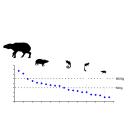
Des prospections géologiques et paléontologiques sur les affleurements continentaux paléogènes du Complexe de Gour Lazib (Hammada du Dra, Algérie) nous ont permis de mettre en évidence plusieurs sites à vertébrés, sur une superficie de plus de cinq cents kilomètres carrés. La faune est constituée de nombreux vertébrés fossiles associant mammifères placentaires, poissons actinoptérygiens et protoptères, squamates, amphibiens, chéloniens, crocodiles et oiseaux. La flore de charophytes est également diversifiée. Les données bio-magnétostratigraphiques indiquent un âge compris entre l’Yprésien terminal et le Lutétien basal pour cet assemblage unique en Afrique. Les nombreux restes de mammifères récoltés ont une préservation exceptionnelle pour le Paléogène ancien arabo-africain et permettent une reconstitution paléoenvironnementale réalisée via une méthode couplant cénogramme et distribution pondérale des taxons arboricoles. Le profil du cénogramme, caractérisé par l’abondance des espèces de petite taille (insectivores, primates et rongeurs), la présence d’espèces de taille intermédiaire (hyracoïdes) et la rareté des grandes espèces (uniquement représentées par les hyracoïdes ; absence notable des proboscidiens et embrithopodes), met en évidence un milieu forestier assez fermé sous climat tropical. Par ailleurs, les données lithologiques et sédimentologiques indiquent un milieu fluviatile méandriforme où ont proliféré les charophytes. Plus hypothétique reste l’existence d’une saisonnalité dans les Gour Lazib, avec de possibles périodes temporaires modérément arides.
Article state: in_press
References
Abdeljaoued, S., 1991. Les dolocrètes et les calcrètes du Paléocène–Éocène, Tunisie méridionale, PhD, Université de Tunis.
Abdeljaoued, S., Bensalah, M., Truc, G., 1998. L'Éocène continental en Afrique du Nord : Essai de corrélations biostratigraphique et paléoclimatique. Impact régional périméditerranéen. Notes du Service Géologique de Tunisie 64, 85-101.
Adaci, M. 2012. Le Paléogène continental du Sud-ouest algérien (Lithostratigraphie, paléontologie et sédimentologie). PhD, Université de Tlemcen.
Adaci, M., Tabuce, R., Mebrouk, F., Bensalah, M., Fabre P-H., Hautier, L., Jaeger, J.-J., Lazzari, V., Mahboubi, M., Marivaux, L., Otero, O., Peigné, S., Tong, H., 2007. Découverte de nouveaux sites à vertébrés dans les formations paléogènes de la région des Gour Lazib/Glib Zegdou (Sahara Nord-occidental, Algérie). Comptes rendus Palévol 6, 535-544. https://doi.org/10.1016/j.crpv.2007.09.001
Adaci, M., Ramdarshan, A., Mebrouk, F., Bensalah, M., Mahboubi, M., Zaoui, D., Tabuce, R., 2009. Extension géographique de la formation continentale éocène du Glib Zegdou et reconstitution paléoenvironnementale de sa faune de mammifères (Éocène inférieur à moyen, Algérie). 1st International Congress on North African Vertebrate Palaeontology, Marrakech, p. 63.
Adaci, M., Bensalah, M., Tabuce, R., Mebrouk, F., Marivaux, L., Otero, O., Zaoui, D., Benyoucef, M., Mahboubi, M., 2016. L’Éocène continental du complexe de Gour Lazib (Sahara nord-occidental, Algérie). Mémoire du Service Géologique de l’Algérie 19, 63-89.
Andrews, P. J. M., Evans, E. M., 1979. Pattern of ecological diversity in fossil and modern mammalian faunas. Biological Journal of the Linnean Society 11, 177-205. https://doi.org/10.1111/j.1095-8312.1979.tb00034.x
Bolle, M.P., Adatte, T., Keller, G., Von Salis, K., Burns, S., 1999. The Paleocene-Eocene transition in the southern Tethys (Tunisia): climatic and environmental fluctuations. Bulletin de la Société Géologique de France 170, 661-680.
Bown, T.M., Kraus, M.J., 1988. Geology and Paleoenvironnement of the Oligocene Jebel Qatrani Formation and Adjacent Rocks, Fayum Depression, Egypt. U.S. Geological Survey Professional Paper 1452, 1-64. https://doi.org/10.3133/pp1452
Carmichael, M. J., Lunt, D. J., Huber, M., Heinemann, M., Kiehl, J., Legrande, A., Loptson, C. A., Roberts, C.D., Sagoo, N., Shields, C., Valdes, P. J., Winguth, A., Winguth, C., Pancost, R.D., 2016. A model–model and data–model comparison for the early Eocene hydrological cycle. Climate of the Past 12, 455-481. https://doi.org/10.5194/cp-12-455-2016
Coster, P., Benammi, M., Mahboubi, M., Tabuce, R., Adaci, M., Marivaux, L., Bensalah, M., Mahboubi, S., Mahboubi, A., Maameri, C., Jaeger, J.-J., 2012. Chronology of the Eocene continental deposits of Africa: magnetostratigraphy and biostratigraphy of the El Kohol and Glib Zegdou Formations, Algeria. Geological Society of America Bulletin 124, 1590-1606. doi: 10.1130/B30565.1 https://doi.org/10.1130/B30565.1
Couvreur, T.L.P., Dauby, G., Blach-Overgaard, A., Deblauwe, V., Dessein, S., Droissart, V., Hardy, O.J., Harris, D.J., Janssens, S.B., Ley, A.C., Mackinder, B.A., Sonke, B., Sosef, M.S.M., Stevart, T., Svenning, J.-C., Wieringa, J.J., Faye, A., Missoup, A.D., Tolley, K.A., Nicolas, V., Ntie, S., Fluteau, F., Robin, C., Guillocheau, F., Barboni, D., Sepulchre, P. 2021. Tectonics, climate and the diversification of the tropical African terrestrial flora and fauna. Biological Reviews 96, 16-51. https://doi.org/10.1111/brv.12644
Fleming, T. H., 1973. Numbers of mammal species in North and Central American forest communities. Ecology 54, 555-563. https://doi.org/10.2307/1935340
Gagnon, M., 1997. Ecological diversity and community ecology in the Fayum sequence (Egypt). Journal of Human Evolution 32, 133-160. https://doi.org/10.1006/jhev.1996.0107
Garcia, G., Mourer-Chauviré, C., Adaci, M., Bensalah, M., Mebrouk, F., Valentin, X., Mahboubi, M., Tabuce, R., 2020. First discovery of avian egg and bone remains (Presbyornithidae) from the Gour Lazib (Eocene, Algeria). Journal of African Earth Sciences 162, 103666. https://doi.org/10.1016/j.jafrearsci.2019.103666
Gevin, P., Mongereau, N., Truc, G., 1975. La Hammada du Dra (Sahara Algerien, Frontière Algero-Marocaine). Etat des connaissances actuelles. Documents du Laboratoire de Géologie, Faculté des Sciences, Lyon, 305-319.
Gingerich, P. D., 1974. Size variability of the teeth of living mammals and the diagnosis of closely related sympatric fossil species. Journal of Paleontology 48, 895-903.
Gingerich, P. D., Smith, B. H., Rosenberg, K., 1982. Allometric scaling on the dentition of primates and prediction of body weight from tooth size fossils. American Journal of Physical Anthropology 58, 81-100. https://doi.org/10.1002/ajpa.1330580110
Godinot, M., Mahboubi, M., 1992. Earliest known simian primate found in Algeria. Nature 357, 324-326. https://doi.org/10.1038/357324a0
Gómez Cano, A.R., García, Yelo, B.A., Hernández Fernández, M., 2006. Cenogramas, análisis bioclimático y muestreo en faunas de mamíferos: implicaciones para la aplicación de métodos de análisis paleoecológico. Estudios Geológicos 62, 135-144. https://doi.org/10.3989/egeol.0662113
Hanquet, C., 2011. Évolution des paléoenvironnements et des paléoclimats au Pléistocène moyen, en Europe méridionale, d’après l’étude des faunes de micromammifères. Archéologie et Préhistoire. PhD, Université Paul Valéry-Montpellier III.
Hernandez Fernandez, M., Alberdi, M. T., Azanza B., Montoya, P., Morales, J., Nieto, M., Pelaez-Campomanes, P., 2006. Identification problems of arid environments in the Neogene-Quaternary mammal record of Spain. Journal of Arid Environments 66 (3), 585-608. https://doi.org/10.1016/j.jaridenv.2006.01.013
Holling, C.S., 1992. Cross-scale morphology, geometry, and dynamics of ecosystems. Ecological Monographs 62 (3), 447-502. https://doi.org/10.2307/2937313
Huber, M., Caballero, R., 2011. The early Eocene equable climate problem revisited. Climate of the Past 7, 603-633. https://doi.org/10.5194/cp-7-603-2011
Legendre, S., 1986. Analysis of mammalian communities from the late Eocene and Oligocene of southern France. Palaeovertebrata, Montpellier 16, 191-212. https://doi.org/10.18563/pv.16.4.191-212
Legendre, S., 1989. Les communautés de mammifères du paléogène (éocène supérieur à oligocène) d'Europe occidentale : structures, milieux et évolution. Münchner Geowissenschaftliche Abhandlungen 16, 1-110.
Lofty, H., Van der Voo, R., 2007. Tropical northeast Africa in the middle-late Eocene: Paleomagnetism of the marine mammal’s sites and basalts in the Fayum province, Egypt. Journal of African Earth Sciences 47, 135-152. https://doi.org/10.1016/j.jafrearsci.2006.12.005
Lunt, D. J., Dunkley Jones, T., Heinemann, M., Huber, M., Legrande, A., Winguth, A., Loptson, C., Marotzke, J., Roberts, C. D., Tindall, J., Valdes, P., Winguth, C., 2012. A model–data comparison for a multi-model ensemble of early Eocene atmosphere–ocean simulations: EoMIP. Climate of the Past 8, 1717-1736. https://doi.org/10.5194/cp-8-1717-2012
Mahboubi, M., 1995. Etude géologique et paléontologique des formations continentales paléocènes et éocènes d'Algérie, Université d'Oran, Institut des Sciences de la Terre. PhD, Université d’Oran, Algérie.
Mahboubi, M., Sudre, J., Tabuce, R., Mebrouk, F., Feist-Castel, M., Vianey-Liaud, M., Crochet, J-Y., Godinot, M., Jaeger, J-J., 2002. État actuel des connaissances sur les formations continentales éocènes de la bordure septentrionale de la Hammada du Draa (régions du Glib Zegdou et des Gour Lazib, Sahara occidental algérien). Mémoire Service Géologique Algérie 11, 155-165.
Marivaux, L., Adaci, M., Bensalah, M., Gomes-Rodrigues, H., Hautier, L., Mahboubi, M., Mebrouk, F., Tabuce, R., Vianey-Liaud, M., 2011a. Zegdoumyidae (Rodentia, Mammalia), stem anomaluroid rodents from the Early to Middle Eocene of Algeria (Gour Lazib, Western Sahara): new dental evidence. Journal of Systematic Palaeontology 9, 563-588. https://doi.org/10.1080/14772019.2011.562555
Marivaux, L., Tabuce, R., Lebrun, R., Ravel, A., Adaci, M., Mahboubi, M., Bensalah, M., 2011b. Talar morphology of azibiids, strepsirhine-related primates from the Eocene of Algeria: phylogenetic affinities and locomotor adaptation. Journal of Human Evolution 61, 447-457. https://doi.org/10.1016/j.jhevol.2011.05.013
Marivaux, L., Ramdarshan, A., Essid, E.M., Marzougui, W., Khayati Ammar, H., Lebrun, R., Marandat, B., Merzeraud, G., Tabuce, R., Vianey-Liaud, M., 2013. Djebelemur, a tiny pre-tooth-combed primate from the Eocene of Tunisia: a glimpse into the origin of crown strepsirhines. PLoS One 8, 1-21. https://doi.org/10.1371/journal.pone.0080778
Marivaux, L., Adnet, S., Benammi, M., Tabuce, R., Benammi, M., 2017. Anomaluroid rodents from the earliest Oligocene of Dakhla, Morocco, reveal the long-lived and morphologically conservative pattern of the Anomaluridae and Nonanomaluridae during the Tertiary in Africa. Journal of Systematic Palaeontology 15 (7), 539-569. https://doi.org/10.1080/14772019.2016.1206977
Marivaux, L., Charruault, A-L., Adaci, M., Bensalah, M., Mahboubi, M., Mebrouk, F., Khayati Ammar, H., Essid, E-M., Marzougui, W., Temani, R., Rodolphe, T., 2025. New insights into the diversity of strepsirrhine primates from the late early-early middle Eocene of North Africa (Algeria and Tunisia). Journal of Human Evolution 206, 1-32. https://doi.org/10.1016/j.jhevol.2025.103729
Matsumoto, H. 1926. Contribution to the knowledge of the fossil hyracoidea of the Fayum, Egypt, with the description of several new species. Bulletin of the American Museum of Natural History 56, 253–350.
Mebrouk, F., 2011. Les charophytes du Maghreb, systématique, biostratigraphie et environnements Crétacés-Paléogènes. PhD, Université d’Oran, Algérie.
Mebrouk F., Mahboubi M., Bessedik M., Feist M., 1997. L'apport des charophytes à la stratigraphie des formations continentales paléogènes de l'Algérie. Geobios 30, 171-177. https://doi.org/10.1016/S0016-6995(97)80221-5
Meyer, G.E., 1978. Hyracoidea. In: Maglio, V.J., Cooke, H.B.S. (eds.), Evolution of African Mammals, Harvard University Press, Cambridge, pp. 284-314. https://doi.org/10.4159/harvard.9780674431263.c15
Montuire, S., 1999. Mammalian faunas as indicators of environmental and climatic changes in Spain since the Pliocene. Quaternary Research, 52, 129-137. https://doi.org/10.1006/qres.1999.2041
Mourer-Chauviré, C., Tabuce, R., Mahboubi, M., Adaci, M., Bensalah, M., 2011. A Phororhacoid bird from the Eocene of Africa. Naturwissenschaften 98, 815-823. https://doi.org/10.1007/s00114-011-0829-5
Muizon, C., Cifelli, R. L., 2000. The “condylarths” (archaic Ungulata, Mammalia) from the early Palaeocene of Tiupampa (Bolivia): implications on the origin of the South American ungulates. Geodiversitas 22 (1), 47-150.
Rage, J.-C., Adaci, M., Bensalah, M., Mahboubi, M., Marivaux, L., Mebrouk, F., Tabuce, R., 2021. Latest Early-early Middle Eocene deposits of Algeria (Glib Zegdou, HGL50), yield the richest and most diverse fauna of amphibians and squamate reptiles from the Palaeogene of Africa. Palaeovertebrata 44, e1. https://doi.org/10.18563/pv.44.1.e1
Ramdarshan, A., 2011. Radiations adaptatives et diversité écologique des primates au début du Tertiaire. PhD, Université Montpellier 2.
Rasmussen, D.T., Simons, E.L., 1988. New Oligocene hyracoids from Egypt, Journal of vertebrate palaeontology 8 (1), 67-83. https://doi.org/10.1080/02724634.1988.10011684
Rasmussen, D.T., 1989. The evolution of the hyracoidea: a review of the fossil evidence. In: Prothero, D.R. and Schoch, R. M. (eds), The Evolution of Perissodactyls, Oxford University Press, 57-76.
Rasmussen, D.T., Simons, E.L., 2000. Ecomorphological diversity among Paleogene hyracoids (Mammalia): a new cursorial browser from the Fayum, Egypt. Journal of Vertebrate Palaeontology 20 (1), 167-176. https://doi.org/10.1671/0272-4634(2000)020[0167:EDAPHM]2.0.CO;2
Ravel, A., Adaci, M., Bensalah, M., Mahboubi, A., Essid, E. M., Marzougui, W., Khayati Ammar, H., Charruault, A.-L., Lebrun, R., Tabuce, R., Vianey-Liaud, M., Marivaux, L., 2015. New philisids (Mammalia, Chiroptera) from the Early–Middle Eocene of Algeria and Tunisia: new insight into the phylogeny, palaeobiogeography and palaeoecology of the Philisidae. Journal of Systematic Palaeontology 13 (8), 691-709. https://doi.org/10.1080/14772019.2014.941422
Ravel, A., Adaci, M., Bensalah, M., Charruault, A.-L., Essid, E. M., Khayati Ammar, H., Mahboubi, M., Marzougui, W., Mebrouk, F., Merzeraud, G., Vianey-Liaud, M., Tabuce, R., Marivaux, L., 2016. Origine et radiation initiale des chauves-souris modernes : nouvelles découvertes dans l’Éocène d’Afrique du Nord. Geodiversitas 38 (3), 355-434. https://doi.org/10.5252/g2016n3a3
Riveline, J., 1986. Les Charophytes du Paléogène et du Miocène inférieur d'Europe occidentale. Biostratigraphie des formations continentales. Cahiers de Paléontologie, Editions du C.N.R.S., Paris.
Robinson, P., Williams, B. A., 1997. Species diversity, tooth size, and shape of Haplomylus (Condylarthra, Hyopsodontidae) from the Powder River Basin, northeastern Wyoming. Contributions to Geology 31, 59-78.
Rodríguez, J. 1999. Use of cenograms in mammalian palaeocology. A critical review. Lethaia 32, 331-347. https://doi.org/10.1111/j.1502-3931.1999.tb00551.x
Seiffert, E. R., 2010. Chronology of Paleogene mammal localities. In: Werdelin, L., Sanders, W.J. (Eds.), Cenozoic Mammals of Africa. University of California Press, Berkeley, pp. 19-26. https://doi.org/10.1525/9780520945425-006
Solé, F., Lhuillier, J., Adaci, M., Bensalah, M., Mahboubi, M., Tabuce, R., 2014. The hyaenodontidans from the Gour Lazib area (?Early Eocene, Algeria): implications concerning the systematics and the origin of the Hyainailourinae and Teratodontinae. Journal of Systematic Paleontology 12 (3), 303-322. https://doi.org/10.1080/14772019.2013.795196
Sudre, J. 1979. Nouveaux mammifères éocènes du Sahara Occidental. Palaeovertebrata 9, 83-115. https://doi.org/10.18563/pv.9.3.83-115
Tabuce, R., 2002. Mammifères du Paléogène ancien d’Afrique du nord occidentale : Systématique, paléobiogéographie et apport à la phylogénie des « ordres » endémiques africains. PhD, Université de Montpellier 2.
Tabuce, R., Mahboubi, M., Sudre, J., 2001. Reassessment of the Algerian Eocene hyracoid Microhyrax. The early diversity and basal phylogeny of the order Hyracoidea (Mammalia). Eclogae geologica Helvetiae 94, 537-545.
Tabuce, R., Marivaux, L., Adaci, M., Bensalah, M., Hartenberger, J.-L., Mahboubi, M., Mebrouk, F., Tafforeau, P., Jaeger, J.-J., 2007. Early Tertiary mammals from North Africa reinforce the molecular Afrotheria clade. Proceedings of the Royal Society B: Biological Sciences 274, 1159-1166. https://doi.org/10.1098/rspb.2006.0229
Tabuce, R., Marivaux, L., Lebrun, R., Adaci, M., Bensalah, M., Fabre, P.-H., Fara, E., Gomes-Rodrigues, H., Hautier, L., Jaeger, J.-J., Lazzari, V., Mebrouk, F., Peigné, S., Sudre, J., Tafforeau, P., Valentin, X., Mahboubi, M., 2009. Anthropoid vs. strepsirhine status of the African Eocene primates Algeripithecus and Azibius: craniodental evidence. Proceedings of the Royal Society B: Biological Science 276, 4087-4094. https://doi.org/10.1098/rspb.2009.1339
Tabuce, R., Seiffert, E. R., Gheerbrant, E., Alloing-Séguier, L., Koenigswald, W. v., 2017. Tooth enamel microstructure of living and extinct hyracoids reveals unique enamel types among mammals. Journal of Mammalian Evolution 24 (1), 91-110. https://doi.org/10.1007/s10914-015-9317-6
Tabuce, R., Adaci, M., Khayati Ammar, H., Bensalah, M., El Mabrouk, E., Mahboubi, M., Marzougui, W., Mebrouk, F., Marivaux, L., Temani, R., 2018. A dwarf among giants: Titanohyrax tantulus (Hyracoidea, Mammalia) from the Eocene of Chambi, Tunisia and Glib Zegdou, Algeria. 5th International Paleontological Congress – Paris, 9th-13th July 2018.
Tabuce, R., 2018. New remains of Chambius cf. kasserinensis from the Eocene of Tunisia and evaluation of proposed affinities for Macroscelidea (Mammalia, Afrotheria). Historical Biology 30, 251-266. https://doi.org/10.1080/08912963.2017.1297433
Travouillon, K. J., Legendre, S., 2009. Using cenograms to investigate gaps in mammalian body mass distributions in Australian mammals. Palaeogeography, Palaeoclimatology, Palaeoecology 272, 69-84. https://doi.org/10.1016/j.palaeo.2008.11.009
Thewissen, J. G. M., 1990. Evolution of Paleocene and Eocene Phenacodontidae (Mammalia, Condylarthra). Museum of Paleontology, University of Michigan. Papers on Paleontology 29, 1-107.
Valverde, J. A., 1964. Remarques sur la structure et l’évolution des communautés de vertébrés terrestres. 1. Structure d’une communauté 2. Rapport entre prédateurs et proies. La Terre et la Vie 111, 121-154. https://doi.org/10.3406/revec.1964.4401
Valverde, J. A., 1967. Estructura de una Comunidad Mediterránea de Vertebrados Terrestres. Consejo Superior de Investigaciones Cientificas, Madrid.
Westerhold, T., Marwan, N., Drury, A. J., Liebrand, D., Agnini, C., Anagnostou, E., Barnet, J. S., Bohaty, S. M., De Vleeschouwer, D., Florindo, F., Frederichs, T., Hodell, D. A., Holbourn, A. E., Kroon, D., Lauretano, V., Littler, K., Lourens, L. J., Lyle, M., Pälike, H., Röhl, U., Tian, J., Wilkens, R. H., Wilson, P. A., Zachos, J. C., 2020. An astronomically dated record of Earth’s climate and its predictability over the last 66 million years. Science 369, 1383-1387. https://doi.org/10.1126/science.aba6853
Williamson, T. E., Lucas, S. G., 1992. Stratigraphy and mammalian biostratigraphy of the Paleocene Nacimiento Formation, southern San Juan Basin. New Mexico Geological Society Guidebook 43, 265-296. https://doi.org/10.56577/FFC-43.265
|
PDF
S.I. Data
|