|
Article
New Squalicorax species (Neoselachii: Lamniformes) from the Lower Maastrichtian of Ganntour phosphate deposit, Morocco
Published online: 05/12/2014
Keywords:
Anacoracidae; Chondrichthyes; Maastrichtian; Morocco; New taxa
https://doi.org/10.18563/pv.38.2.e3
Cited by: 15
Cite this article:
Henri Cappetta, Sylvain Adnet, Driss Akkrim and Mohammed Amalik, 2014. New Squalicorax species (Neoselachii: Lamniformes) from the Lower Maastrichtian of Ganntour phosphate deposit, Morocco. PalaeoVertebrata 38 (2)-e3. doi: 10.18563/pv.38.2.e3
Export citation
Abstract
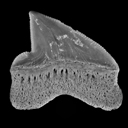
Two new Squalicorax species, S. benguerirensis nov. sp. and S. microserratus nov. sp. are described from the Lower Maastrichtian of the Benguérir phosphate open mine, Ganntour deposit, Morocco. The species S. benguerirensis nov. sp. was classically assigned to S. yangaensis since Arambourg (1952) and has been also recognized in coeval deposits from eastern USA to Mid-East. The species S. microserratus nov. sp. correspond to the lateral teeth of S. kaupi as reported by Arambourg (1952) and which is now referred in fact to S. bassanii. The comparison of these two new species with other Anacoracids, known in Moroccan or elsewhere, allows highlighting the great taxonomic and ecological diversities of this family during the Cretaceous.
Published in Vol.38-2 (2014)
References
Agassiz, L., 1843 (1837-43). Recherches sur les poissons fossiles. 3, 390 + 32 p.
Antunes, M. T. & Cappetta, H., 2002. Sélaciens du Crétacé (Albien-Maastrichtien) d’Angola. Palaeontographica, Abt. A 264, 85-146.
Arambourg, C., 1952. Les vertébrés fossiles des gisements de phosphates (Maroc-Algérie-Tunisie). Notes et Mémoires du Service Géologique du Maroc 92, 1-372.
Bardet, N., Cappetta, H., Pereda Suberbiola, X., Mouty, M., Al Maleh, A. K., Ahmad, A. M., Khrata, O. & Gannoum, N., 2000. The marine vertebrate faunas from the Late Cretaceous Phosphates of Syria. Geological Magazine 137, 269-290. http://dx.doi.org/10.1017/S0016756800003988
Berg, L. S., 1958. System der rezenten und fossilen Fischartigen und Fische. XI + 310 p.
Bernardez, E., 2002. Los dientes de seláceos del Cretácico de la depresión central asturiana. Unpubl. PhD, Oviedo Univ., 1-476.
Blake, D. B. & Reid, R. I., 1998. Some Albian (Cretaceous) asteroids (Echinodermata) from Texas and their paleobiological implications. Journal of Paleontology 72, 512-532. http://dx.doi.org/10.1017/S002233600002429X
Boujo, A., 1968. Nouvelles données sur le Crétacé et l’Eocène phosphaté du gisement des Ganntour. Notes du Service Géologique du Maroc 28, 7-15.
Boujo, A., 1976. Contribution à l’étude géologique du gisement de phosphate crétacé-éocène des Ganntour (Maroc occidental). Notes et Mémoires du Service Géologique du Maroc 262, 1-227.
Bourdon, J., Wright, K., Lucas, S. G., Spielmann, J. A. & Pence, R. 2011. Selachians from the Upper Cretaceous (Santonian) Hosta Tongue of the Point Lookout Sandstone, central New Mexico. Bulletin of the New Mexico Museum of Natural History and Science 52, I-IV + 1-54.
Burris, J. H., 1998. Evidence for reworking of Cretaceous elasmobranch teeth and implications for the provenance of the Paleocene Hanna Formation. Master Thesis, Univ. Wyoming, 71 pp.
Burris, J. H., 1999. Reworked Cretaceous elasmobranch teeth and provenance of the Paleocene Hanna Formation. Journal of Vertebrate Paleontology 19, 34A-35A.
Cappetta, H., 1977. Observations sur quelques sélaciens du Crétacé supérieur d’Angleterre avec la description d’un genre nouveau. Geobios 10, 479-485. http://dx.doi.org/10.1016/S0016-6995(77)80029-6
Cappetta, H., 1987. Mesozoic and Cenozoic Elasmobranchii, Chondrichthyes II. In: Handbook of Paleoichthyology. 3B, 193 p.
Cappetta, H., 1991. Découverte de nouvelles faunes de sélaciens (Neoselachii) dans les phosphates maastrichtiens de la Mer Rouge, Egypte. Münchner Geowissenschaftliche Abhandlungen, (A: Geologie und Paläontologie) 19, 17-56.
Cappetta, H., 2006. Elasmobranchii post-Triadici (index specierum et generum). Fossilium Catalogus, I. Animalia, Pars 142, 1-472.
Cappetta, H., 2012. Chondrichthyes (Mesozoic and Cenozoic Elasmobranchii: teeth) In: Handbook of Paleoichthyology. 3E, 1-512.
Cappetta, H. & Case, G. R., 1975. Sélaciens nouveaux du Crétacé du Texas. Geobios 8, 303-307. http://dx.doi.org/10.1016/S0016-6995(75)80028-3
Cappetta, H. & Case, G. R., 1999. Additions aux faunes de sélaciens du Crétacé du Texas (Albien supérieur-Campanien). Palaeo Ichthyologica 9, 5-111.
Cappetta, H., Pfeil, F. & Schmidt-Kittler, N., 2000. New biostratigraphical data on the marine Upper Cretaceous and Palaeogene of Jordan. Newsletters on Stratigraphy 38, 81-95.
Cappetta, H., Bardet, N., Pereda-Suberbiola, X., Adnet, S., Akkrim, D., Amalik, M. & Benabdallah, A., 2014. Marine vertebrate faunas from the Maastrichtian phosphate deposits of the Benguérir area (Ganntour Basin, Morocco): biostratigraphy, palaeobiogeography and palaeoecology. Palaeogeography, Palaeoclimatology, Palaeoecology 409, 217-238. http://dx.doi.org/10.1016/j.palaeo.2014.04.020
Case, G. R. & Cappetta, H., 2004. Additions to the elasmobranch fauna from the late Cretaceous of New Jersey (lower Navesink Formation, Early Maastrichtian). Palaeovertebrata 33, 1–16.
Casier, E., 1947. Constitution et évolution de la racine dentaire des Euselachii. II- Etude comparative des types. Bulletin de l’Institut royal des Sciences naturelles de Belgique 23, 1-32.
Cope, E. D., 1872. On the families of fishes of the Cretaceous formation in Kansas. Proceedings of the American Philosophical Society 12, 327-357.
Coquand, H., 1860. Description physique, géologique, paléontologique et minéralogique du département de la Charente. 2, 542 pp.
Dalinkevicius, J. A., 1935. On the fossil fishes of the Lithuanian Chalk. I. Selachii. Mémoires de la Faculté des Sciences de l’Université Vytautas le Grand 9, 243-305.
Dartevelle, E. & Casier, E., 1943. Les poissons fossiles du Bas-Congo et des régions voisines. Annales du Musée du Congo Belge, Sér. A (Minéralogie, Géologie, Paléontologie) 3, 2, 1-200.
Dartevelle, E. & Casier, E., 1959. Les poissons fossiles du Bas-Congo et des régions voisines (Troisième partie). Annales du Musée du Congo Belge, Sér. A (Minér., Géol., Paléont.) 3, 2, 257-568.
Davis, J. W., 1890. On the fossil fish of the Cretaceous formations of Scandinavia. Scientific Transactions of the royal Dublin Society 2, 363-434.
Dixon, F., 1850. The geology of Sussex or the geology and fossils of the Tertiary and Cretaceous formations of Sussex. XVI + 422 p., 2nd edit.
Dutheil, D., 1996. Elasmobranches du Crétacé supérieur remaniés dans le paléocène inférieur de Vertus (Marne, France). La limite Crétacé-Tertiaire : Aspects biologiques et géologiques. Séance spécialisée de la Soc. Géol. de France, Paris, 2-3 décembre, 1 p.
Eaton, J. G., Kirkland, J. I. & Doi, K., 1989. Evidence of reworked Cretaceous fossils and their bearing on the existence of Tertiary dinosaurs. Palaios 4, 281-286. http://dx.doi.org/10.2307/3514776
Egerton, P., 1844. On the remains of fishes found by Mr. Kaye and Mr. Cunliffe in the Pondicherry beds. Proceedings of the Geological Association of London 4, 381-388.
Erichsen de Oliveira, P. & Silva Santos, R. da, 1950. Fósseis Cretáceos da ilha de Itamaracá. Anais da Academia Brasileira de Ciências 22, 107-112.
Eudes-Deslongchamps, E., 1877. Le Jura normand. Monographie IV. Marnes infra-oolithiques, assises inférieures. 60 p.
Forbes, H. O., 1892. Aphanapteryx and other remains in the Chatham Islands. Nature 46, 252-253. http://dx.doi.org/10.1038/046252a0
Gemmellaro, M., 1920. Ittiodontoliti Maëstrichtiani di Egitto. Atti dell’Accademia di Scienze di Palermo 11, 149-204.
Giebel, C. G., 1848. Fauna der Vorwelt, mit steter Berücksichtigung der lebenden Thiere. Erster Band: Wirbelthiere. Dritte Abtheilung: Fische. I-XII + 1-467.
Glikman, L. S., 1956. Phylogeny of the genus Anacorax. Doklady Akademii Nauk SSSR 109, 1049-1052.
Glikman, L. S., 1964. Sharks of Paleogene and their stratigraphic significance. Nauka Press 229 p.
Glikman, L. S., 1980. Evolution of Cretaceous and Cenozoic Lamnoid sharks. Izd. Nauka 248 p.
Glikman, L. S. & Shvazaite, R. A., 1971. Sharks of the family Anacoracidae from the Cenomanian and Turonian of Lithuania, Volga region and middle Asia. Paleontology Stratigraphy Pribaltiki Belorussii 3, 185-192.
Glikman, L. S. & Zhelezko, V. I., 1979. Sélaciens in «La limite Santonien-Campanien sur la plateforme de l’Est européen». Akademia Nauk CCCP 90-105.
Guinot, G., Underwood, C. J., Cappetta, H. & Ward, D. J., 2013. Sharks (Elasmobranchii: Selachii) from the Late Cretaceous of France and the UK. Zoological Journal of the Linnean Society of London 11, 589-671. http://dx.doi.org/10.1080/14772019.2013.767286
Herman, J., 1977. Les sélaciens des terrains néocrétacés et paléocènes de Belgique et des contrées limitrophes. Eléments d’une biostratigraphie intercontinentale. Mémoires pour servir à l’explication des Cartes géologiques et minières de la Belgique, 1975 (paru 1977) 15, 401 p.
Herman, J. & Van Den Eeckhaut, G., 2010. Inventaire systématique des Invertebrata, Vertebrata, Plantae et Fungi des Sables de Bruxelles à Zaventem. Geominpal Belgica 1, 35-65.
Herman, J. & Van Waes, H., 2012. Observations concernant l’évolution et la systématique de quelques Euselachii, Neoselachii et Batoidei (Pisces - Elasmobranchii), actuels et fossiles. Géominpal Belgica 2, 1-89.
Hussakof, L., 1908. Catalogue of the type and figured specimens of fossil vertebrates in the American Museum of Natural History. Part. I. Fishes. Bulletin of the American Museum of Natural History 25, 1-103.
Jallad, I. S., Abu-Murray, O. S. & Sadaqah, R. M., 1989. Upper Cretaceous phosphorites of Jordan, In: Phosphate deposits of the world, A.J.G. Notholt, R.P. Sheldon & D.F. Davidson (eds.), Cambridge Univ. Press, 54, 344-351.
Landemaine, O., 1991. Sélaciens nouveaux du Crétacé supérieur du Sud-Ouest de la France. Quelques apports à la systématique des élasmobranches. Société Amicale des Géologues Amateurs 1, 1-45.
Ledru, A.-P., 1810. Voyage aux Iles de Ténériffe, La Trinité, Saint-Thomas, Sainte-Croix et Porto-Ricco. Arthus-Bertrand, Paris 1, 1-315.
Leidy, J., 1873. Contributions to the extinct vertebrate fauna of the Western Territories. Report of the United States Geological Survey Territories 1, 14-358. http://dx.doi.org/10.5962/bhl.title.61805
Leriche, M., 1911. Liste des poissons fossiles de la Glauconie de Lonzée, près Gembloux (Namur) in M. Mourlon: Texte explicatif du levé géologique de la planchette de Gembloux. Service Géologique de Belgique, 7.
Leriche, M., 1929. Les poissons du Crétacé marin de la Belgique et du Limbourg hollandais (note préliminaire). Les résultats stratigraphiques de leur étude. Bulletin de la Société Belge de Géologie, de Paléontologie et d’Hydrologie 37, 199-299.
Leriche, M., 1938. Contribution à l’étude des poissons fossiles des pays riverains de la Méditerranée américaine (Vénézuéla, Trinité, Antilles, Mexique). Mémoires de la Société Paléontologique Suisse 61, 42 p.
Lucas, J. & Prévôt-Lucas, L., 1996. Tethyan phosphates and bioproductites. In: The Ocean Basins and Margins, vol. 8, The Tethys Ocean, 367-391.
Mertiniene, R. A., 1978. Répartition zonale des dépôts albiens et cénomaniens de la partie occidentale de la plateforme de l’Est Européen d’après les dents de requins. Stratigr. Faner. Pribalt. Paleont. konileskoi, stroen. sost. otlosn. 110-117.
Müller, A. & Diedrich, C., 1991. Selachier (Pisces, Chondrichthyes) aus dem Cenomanium von Ascheloh am Teutoburger Wald (Nordrhein-Westfalen, NW-Deutschland). Geologie und Paläontologie in Westfalen 20, 3-105.
Münster, G. v., 1842. Beschreibungen einiger fossiler Fischzähne aus dem Tertiär-Becken von Wien, mit den beiden neuen Gattungen Capitodus und Soricidens. Beiträge zur Petrefakten-Kunde 5, 65-69.
Nessov, L. A., Sigogneau-Russell, D. & Russell, D. E., 1994. A survey of Cretaceous tribosphenic mammals from Middle Asia (Uzbekistan, Kazakhstan and Tajikistan), of their geological setting, age and faunal environment. Palaeovertebrata 23, 51-92.
Noetling, F., 1885. Die fauna des Baltischen Cenoman-Geschiebe. Geologische und Palaeontologische Abhandlungen 2, 52 p.
Noubhani, A. & Cappetta, H., 1997. Les Orectolobiformes, Carcharhiniformes et Myliobatiformes (Elasmobranchii, Neoselachii) des bassins à phosphate du Maroc (Maastrichtien-Lutétien basal). Systématique, biostratigraphie, évolution et dynamique des faunes. Palaeo Ichthyologica 8, 1-327.
Prabhulingaiah, G., Qutami, H. & Dassin, Y., 2014. Eshidiya Phosphate Deposit-Jordan. International Journal of Applied Life Sciences and Engineering 1, 77-78.
Priem, F., 1897. Sur des dents d’élasmobranches de divers gisements sénoniens (Villedieu, Meudon, Folx-les-Caves). Bulletin de la Société géologique de France 25, 40-56.
Priem, F., 1898. Sur des pycnodontes et des squales du Crétacé supérieur du Bassin de Paris (Turonien, Sénonien, Montien inférieur). Bulletin de la Société géologique de France 26, 229-243.
Rebouças, J. C. & Silva Santos, R. da, 1956. Fauna ictiológica do fosfato de Pernambuco. Divisão Geologia e Mineralogia, Boletim 162, 1-29.
Reuss, A. E., 1845. Die Versteinerungen der böhmischen Kreideformation. Erste Abtheilung. IV + 58 p.
Sharpe, R. B., 1877. Catalogue of the birds in the British Museum. III. Catalogue of Passeriformes, or perching birds, in the collection of the British Museum, 1-344.
Schwimmer, D. R., Stewart, J. D. & Williams, G. D., 1997. Scavenging by sharks of the genus Squalicorax in the Late Cretaceous of North America. Palaios 12, 71-83. http://dx.doi.org/10.2307/3515295
Shimada, K., 2008. New anacoracid shark from Upper Cretaceous Niobrara Chalk of western Kansas, U.S.A. Journal of Vertebrate Paleontology 28, 1189-1194. http://dx.doi.org/10.1671/0272-4634-28.4.1189
Siverson, M., 1992. Biology, dental morphology and taxonomy of Lamniform sharks from the Campanian of the Kristianstad basin, Sweden. Palaeontology 35, 519-554. http://dx.doi.org/10.1111/j.1475-4983.2007.00691.x
Siverson, M., Lindgren, J. & Kelley, L. S., 2007. Anacoracid sharks from the Albian (Lower Cretaceous) Pawpaw shale of Texas. Palaeontology 50, 939-950.
Slaughter, B. H. & Thurmond, J. T., 1974. A Lower Cenomanian (Cretaceous) ichthyofauna from the Bahariya Formation of Egypt. Annals of the Geological Survey of Egypt 4, 25-40.
Sokolov, M., 1978. Sharks as fossil-guides for the zonation and the subdivison of the Cretaceous strata of Touransk. Izdatel’stvo Niedra, 61 p.
Stromer, E., 1927. Ergebnisse der Forschungsreisen Prof. E. Stromers in den Wüsten Ägyptens. II. Wirbeltier-Reste der Baharije-Stufe (Unterstes Cenoman). 9. Die Plagiostomen mit einem Anhang über käno- und mesozoische Rückenflossenstacheln von Elasmobranchiern. Abhandlungen der Bayerischen Akademie der Wissenschaften, Mathematisch-naturwissenschaftliche Abteilung, Neue Funde 31, 1-64.
Taverne, L., 1970. Les poissons fossiles et quelques dents de reptiles récoltés par C.R. Hoffmann dans le Crétacé supérieur de Vonso (Bas-Congo). Annales du Musée royal de l’Afrique Centrale, Sciences Géologiques 70, 1-44.
Underwood, C. J. & Cumbaa, S. L., 2010. Chondrichthyans from a Cenomanian (Late Cretaceous) bonebed, Saskatchewan, Canada. Palaeontology 53, 903-944. http://dx.doi.org/10.1111/j.1475-4983.2010.00969.x
Uyeno, T. & Suzuki, C., 1995. Squalicorax and some other shark teeth from an upper Cretaceous Bed in Iwaki City, Japan. Memoirs of the National Science Museum 28, 59-64.
Vullo, R., Cappetta, H. & Neraudeau, D., 2007. New sharks and rays fom the Cenomanian and Turonian of Charentes, France. Acta Palaeontologica Polonica 52, 99-116.
Welton, B. J. & Farish, R. F., 1993. The collector’s guide to fossil sharks and rays from the Cretaceous of Texas. 204 p.
Werner, C., 1989. Die Elasmobranchier-Fauna des Gebel Dist Member der Bahariya Formation (Obercenoman) der Oase Bahariya, Ägypten. Palaeo Ichthyologica 5, 1-112.
White, E. I. & Moy-Thomas, J. A., 1940. Notes on the nomenclature of fossil fishes. Part. I: Homonyms A–C. Annals and Magazine of Natural History 11, 502-507. http://dx.doi.org/10.1080/00222934008527067
Whitley, G. P., 1939. Taxonomic notes on sharks and rays. Australian Zoologist 9, 227-262.
Whitley, G. P., 1965. Some fish genera scrutinized. Royal Zoological Society of New South Wales, 25-26.
Williston, S. W., 1900a. Some fish teeth from the Kansas Cretaceous. Kansas University Quarterly 9, 27-42.
Williston, S. W., 1900b. Cretaceous fishes. Selachians and Ptychodonts. University Geological Survey of Kansas 6, 237-256.
Winkler, T. C., 1876. Mémoire sur quelques restes de poissons du système heersien. Archives du Musée Teyler 4, 1-15.
Woodward, A. S., 1889. Catalogue of the fossil fishes in the British Museum. Part. I. Containing the Elasmobranchii. Trustees of the British Museum (Natural History) XLVII + 474 p.
Zhelezko, V. I., 1977. Stratigraphy and fossil sharks of the Upper Cretaceous deposits of West Kazakhstan. Rotaprint Geotekhnika, 1-31.
Zhelezko, V. I., 1987. Les sélaciens du Santonien et du Campanien inférieur de l’Oural méridional et des Mugodzhars. Academia Nauk CCCP, 117-130.
Zhelezko, V. I., 1990. Sélaciens in «Dépôts du Crétacé supérieur de la Transouralie du Sud», (G.N. Papulov, V.I. Zhelezko & A.P. Levina Eds). Académie des Sciences d’U.R.S.S., Section de l’Oural, 122-133.
Zhelezko, V. I., 1995. Biostratigraphy of Cretaceous-Paleogene Phosphorite Formations of Trans Urals and North-Western Kazakhstan on Elasmobranchia. Ekaterinburg Press, 1-42.
Zhelezko, V. I., 1997. Echelle zonale stratigraphique chronologique du Crétacé supérieur d’Eurasie d’après les poissons apparentés aux requins. Institut de Géologie et Géochimie, Académie Zavaritsko, 9-13.
Zhelezko, V. I., 1990. Sélaciens in «Dépôts du Crétacé supérieur de la Transouralie du Sud», (G.N. Papulov, V.I. Zhelezko & A.P. Levina Eds). Académie des Sciences d’U.R.S.S., Section de l’Oural, 122-133.
Cited by:
Kelly N. Bice and Kenshu Shimada (2016). Fossil marine vertebrates from the Codell Sandstone Member (middle Turonian) of the Upper Cretaceous Carlile Shale in Jewell County, Kansas, USA. Cretaceous Research. https://doi.org/10.1016/j.cretres.2016.04.017
Romain Vullo, Guillaume Guinot and Gérard Barbe (2016). The first articulated specimen of the Cretaceous mackerel sharkHaimirichia amonensisgen. nov. (Haimirichiidae fam. nov.) reveals a novel ecomorphological adaptation within the Lamniformes (Elasmobranchii). Journal of Systematic Palaeontology. https://doi.org/10.1080/14772019.2015.1137983
José-Carmelo Corral, Ana Berreteaga and Henri Cappetta (2016). Upper Maastrichtian shallow marine environments and neoselachian assemblages in North Iberian palaeomargin (Castilian Ramp, Spain). Cretaceous Research. https://doi.org/10.1016/j.cretres.2015.08.001
Guntupalli V. R. Prasad, Vishal Verma, Ashok Sahni, Ranjit S. Lourembam and Priyadarshini Rajkumari (2017). Elasmobranch fauna from the upper most part of the Cretaceous Bagh Group, Narmada valley, India. Island Arc. https://doi.org/10.1111/iar.12200
Guillaume Guinot and Jorge D. Carrillo-Briceño (2018). Lamniform sharks from the Cenomanian (Upper Cretaceous) of Venezuela. Cretaceous Research. https://doi.org/10.1016/j.cretres.2017.09.021
Alejandro Niño Garcia, Juan Diego Parra Mosqura and Peter Anthony Macias Villarraga (2019). Registro de condrictios del cretácico superior de la formación loma gorda. Boletín de Ciencias de la Tierra. https://doi.org/10.15446/rbct.n46.78525
Yasser Salama, Naif G Altoom, Ahmed a Allam, Jamaan S Ajarem and Shahin Abd-Elhameed (2021). Late Cretaceous anacoracid sharks (Squalicorax) from Duwi Formation, Gebel Duwi, central Eastern Desert, Egypt: qualitative and quantitative analyses. Historical Biology. https://doi.org/10.1080/08912963.2020.1847102
Patrick L. Jambura, Sebastian Stumpf and Jürgen Kriwet (2021). Skeletal remains of the oldest known pseudocoracid shark Pseudocorax kindlimanni sp. nov. (Chondrichthyes, Lamniformes) from the Late Cretaceous of Lebanon. Cretaceous Research. https://doi.org/10.1016/j.cretres.2021.104842
Kenshu Shimada, Martin A. Becker and Michael L. Griffiths (2021).
Body, jaw, and dentition lengths of macrophagous lamniform sharks, and body size evolution in Lamniformes with special reference to ‘off-the-scale’ gigantism of the megatooth shark,
Otodus megalodon
. Historical Biology. https://doi.org/10.1080/08912963.2020.1812598
Harry M. Maisch, Martin A. Becker and Kenshu Shimada (2021). Fossil fishes from a lag deposit within the Upper Cretaceous Mancos Shale in New Mexico, USA, with comments on correlative Turonian–Coniacian time-transgressive lags in the Western Interior Seaway of North America. Cretaceous Research. https://doi.org/10.1016/j.cretres.2021.104886
Samuel L.A. Cooper, Kyle J. Marson, Roy E. Smith and David Martill (2022). Contrasting preservation in pycnodont fishes reveals first record of regurgitalites from the Upper Cretaceous (Maastrichtian) Moroccan phosphate deposits. Cretaceous Research. https://doi.org/10.1016/j.cretres.2021.105111
Salim Boulemia and Sylvain Adnet (2023). A new Palaeogene elasmobranch fauna (Tebessa region, eastern Algeria) and the importance of Algerian-Tunisian phosphates for the North African fossil record. Annales de Paléontologie. https://doi.org/10.1016/j.annpal.2023.102632
Patrick L. Jambura, Sergey V. Solonin, Samuel L.A. Cooper, Eduard V. Mychko, Maxim S. Arkhangelsky, Julia Türtscher, Manuel Amadori, Sebastian Stumpf, Alexey V. Vodorezov and Jürgen Kriwet (2024). Fossil marine vertebrates (Chondrichthyes, Actinopterygii, Reptilia) from the Upper Cretaceous of Akkermanovka (Orenburg Oblast, Southern Urals, Russia). Cretaceous Research. https://doi.org/10.1016/j.cretres.2023.105779
Alexandre Assemat, Sylvain Adnet and Jeremy E. Martin (2025). Reconstructing the trophic structure of Maastrichtian elasmobranch communities in Morocco using calcium isotopes. Gondwana Research. https://doi.org/10.1016/j.gr.2025.05.021
Ahmed Hefny, Mohamed K. AbdelGawad, Gamal El Qot, Abdelminem El Araby and Mohamed F. Aly (2026). New hybodontiform material from the upper Cenomanian Galala Formation of Wadi Qena (central Eastern Desert, Egypt). Historical Biology. https://doi.org/10.1080/08912963.2025.2522776
|
PDF
|