
Book of Abstracts of the XXII Annual Meeting of the European Association of Vertebrate Palaeontologists, 30 June–5 July 2025, Kraków, Poland
Pterosaurs from Coahuila
Early Oligocene Fishes from Alabama, USA
Oldest evening bat from the Early Eocene of France
The digital endocast of Necrolemur antiquus
stapes trapped in artiodactyls bony labyrinth
Eocene (57) , Quercy Phosphorites (38) , Systematics (32) , Rodents (29) , Mammalia (27) , Rodentia (25) , Miocene (24)
Page 1 of 1, showing 1 record(s) out of 1 total
|
|
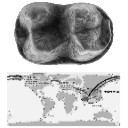
First early Eocene tapiroid from India and its implication for the paleobiogeographic origin of perissodactylsThierry Smith, Floréal Solé, Pieter Missiaen, Rajendra Rana, Kishor Kumar, Ashok Sahni and Kenneth D. RosePublished online: 9/8/15Keywords: Ceratomorpha; Helaletidae; Paléogène; Tapiromorpha; Vastan https://doi.org/10.18563/pv.39.2.e5 Abstract The presence of cambaytheres, the sister group of perissodactyls, in western India near or before the time of collision with Asia suggests that Perissodactyla may have originated on the Indian Plate during its final drift towards Asia. Herein we reinforce this hypothesis by reporting two teeth of the first early Eocene tapiromorph Perissodactyla from the Cambay Shale Formation of Vastan Lignite Mine (c. 54.5 Ma), Gujarat, western India, which we allocate to a new genus and species, Vastanolophus holbrooki. It presents plesiomorphic characters typical of the paraphyletic “Isectolophidae,” such as small size and weak lophodonty. However, the weaker hypoconulid and low paralophid, higher cusps, lower cristid obliqua, and the lingual opening of the talonid are found in Helaletidae, the most primitive tapiroid family. V. holbrooki, gen. et sp. nov., may be the oldest and the most primitive tapiroid, suggesting that at least tapiroid perissodactyls originated on India. PV article infos Published in Vol.39-2 (2015) |
|
Page 1 of 1, showing 1 record(s) out of 1 total