
Book of Abstracts of the XXII Annual Meeting of the European Association of Vertebrate Palaeontologists, 30 June–5 July 2025, Kraków, Poland
Pterosaurs from Coahuila
Early Oligocene Fishes from Alabama, USA
Oldest evening bat from the Early Eocene of France
The digital endocast of Necrolemur antiquus
stapes trapped in artiodactyls bony labyrinth
Eocene (57) , Quercy Phosphorites (38) , Systematics (32) , Rodents (29) , Mammalia (27) , Rodentia (25) , Miocene (24)
Page 1 of 1, showing 1 record(s) out of 1 total
|
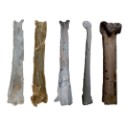
The geologically youngest remains of an ornithocheirid pterosaur from the late Cenomanian (Late Cretaceous) of northeastern Mexico with implications on the paleogeography and extinction of Late Cretaceous ornithocheiridsEberhard D. Frey, Wolfgang Stinnesbeck, David M. Martill, Héctor E. Rivera-Sylva and Héctor Porras MúzquizPublished online: 7/21/20Keywords: Coahuila; Late Cenomanian; north-eastern Mexico; Ornithocheiridae; Pterosauria https://doi.org/10.18563/pv.43.1.e4 Abstract Ornithocheirid pterosaurs were the largest of the toothed pterodactyloids and had a worldwide distribution, although their fossil record is fragmentary, with the exception of the north-eastern Brazilian Crato and Santana Formations (Aptian, ?Albian, Early Cretaceous). With Istiodactylidae, they were also the only toothed pterosaurs that survived into the Cenomanian (Late Cretaceous), becoming extinct at the end of this period. Here we report on an ornithocheirid metacapus from the Late Cenomanian laminated limestone of north-eastern Mexico discovered about 120 km north-west of Ciudad Acuña, northern Coahuila at the south banks of Rio Bravo. The specimen comprises a fragmentary distal syncarpal, a crushed but complete metacarpal IV, two fragmentary preaxial metacarpals and a possible fragmentary terminal left wing finger phalanx. It represents the geologically youngest known ornithocheirid worldwide. We suggest that ornithocheirid pterosaurs may have become extinct because of massive sea level fluctuations during the mid to late Cretaceous that may have obliterated their breeding sites on coastal plains and low lying islands. PV article infos Published in Vol 43-1 (2020) |
|
Page 1 of 1, showing 1 record(s) out of 1 total