
Book of Abstracts of the XXII Annual Meeting of the European Association of Vertebrate Palaeontologists, 30 June–5 July 2025, Kraków, Poland
Pterosaurs from Coahuila
Early Oligocene Fishes from Alabama, USA
Oldest evening bat from the Early Eocene of France
The digital endocast of Necrolemur antiquus
stapes trapped in artiodactyls bony labyrinth
Eocene (57) , Quercy Phosphorites (38) , Systematics (32) , Rodents (29) , Mammalia (27) , Rodentia (25) , Miocene (24)
Page 1 of 1, showing 1 record(s) out of 1 total
|
|
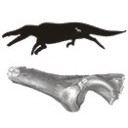
First record of the family Protocetidae in the Lutetian of Senegal (West Africa)Lionel Hautier, Raphaël Sarr, Fabrice Lihoreau, Rodolphe Tabuce and Pierre Marwan HamehPublished online: 12/5/14Keywords: innominate; Lutetian; Protocetid; Senegal https://doi.org/10.18563/pv.38.2.e2 Abstract The earliest cetaceans are found in the early Eocene of Indo-Pakistan. By the late middle to late Eocene, the group colonized most oceans of the planet. This late Eocene worldwide distribution clearly indicates that their dispersal took place during the middle Eocene (Lutetian). We report here the first discovery of a protocetid fossil from middle Eocene deposits of Senegal (West Africa). The Lutetian cetacean specimen from Senegal is a partial left innominate. Its overall form and proportions, particularly the well-formed lunate surface with a deep and narrow acetabular notch, and the complete absence of pachyostosis and osteosclerosis, mark it as a probable middle Eocene protocetid cetacean. Its size corresponds to the newly described Togocetus traversei from the Lutetian deposits of Togo. However, no innominate is known for the Togolese protocetid, which precludes any direct comparison between the two West African sites. The Senegalese innominate documents a new early occurrence of this marine group in West Africa and supports an early dispersal of these aquatic mammals by the middle Eocene. PV article infos Published in Vol.38-2 (2014) |
|
Page 1 of 1, showing 1 record(s) out of 1 total