|
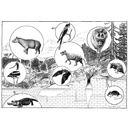
Essai de reconstitution d'un paysage du Quercy vers -35 Ma. (Esquisse de Christian Pondeville, 1977).
Published online: 15/09/1978
Keywords:
Landscape reconstruction; Quercy Phosphorites
https://doi.org/10.18563/pv.8.2-4.landscape
Abstract
Le Quercy est aujourd'hui un vaste plateau calcaire, parcouru par un réseau karstique actif, pro· fondément entaillé par des vallées aux falaises abruptes, comme celles du Lot ou du Célé. Sur un sol peu épais domine la forêt de chênes, accompagnés de cornouillers, érables, genévriers. La faune est pauvre, peu diverse, et les nombreux chasseurs se satisfont de gibier d'élevage ...
Il y a trente-cinq millions d'années environ, le paysage était bien différent. La période de l'Eocène supérieur, qui s'achevait, avait été chaude et humide, si l'on se réfère à la fois aux paléotempératures (calculées à partir de sédiments marins extra-européens) et aux restes fossilisés de végétaux typiquement tropicaux.
Le Causse du Quercy devait être un plateau très disséqué par la karstification, à surface lapiazée creusée de gouffres en rapide évolution interne, et couvert d'un sol assez épais. Une forêt tropicale humide, avec notamment des Myricacées et des gymnospermes, recouvrait l'ensemble du pays, à peine interrompue au niveau des rares points d'eaux situés dans les bas-fonds. Dans ce cadre vivait une faune considérablement différente de la maigre faune actuelle. Si nous pouvons l'imaginer, c'est grâce aux cadavres des animaux entraînés dans les cavités par les eaux courantes ou les prédateurs, ou bien logeant et mourant dans les milieux souterrains. Nombre de ces restes, fossilisés, sont parvenus jusqu'à nous et sont aujourd'hui l'objet d'étude.
View editorial
Published in Vol. 08, Fasc. 2-4 (1978)
|
PDF
|

|
New records of terrestrial Mammals from the upper Eocene Qasr el Sagha Formation, Fayum Depression, Egypt
Published online: 16/12/1996
Keywords:
Egypt; Eocene; Fossil mammals; Qasr el Sagha Formation
https://doi.org/10.18563/pv.25.2-4.175-192
Abstract
New records of terrestrial mammals from the Qasr el Sagha Formation, Fayum Depression, Egypt are reported, and the stratigraphic occurrences of these fossils noted. These include additional specimens of Moeritheríum, Barytherium, and anthracotheres, as well as the oldest record of a hyracoid in the Fayum.These Eocene mammals occur almost exclusively in the alluvial deposits of the Dir Abu Lifa Member of the Qasr el Sagha Formation and show close affinities to the faunas from the lower sequence of the Jebel Qatrani Formation. There is no evidence of a more marked faunal discontinuity between the Qasr el Sagha and Jebel Qatrani Formations than there is across any of the three major breaks in sedimentation that exist within the Jebel Qatrani Formation. The faunal similarities between fossils of the lower sequence of the Jebel Qatrani Formation and of the upper part of the Qasr el Sagha Formation is consistent with recent paleomagnetic dating that suggests that these rocks differ in age by only one to two million years.
PV article infos
Published in Vol. 25, Fasc. 2-4 (1996)
|
PDF
|

|
La poche à phosphate de Ste-Neboule (Lot) et sa faune de vertébres du Ludien Supérieur. 1 La poche et son remplissage
Published online: 15/09/1978
Keywords:
Eocene; Quercy Phosphorites
https://doi.org/10.18563/pv.8.2-4.171-173
Abstract
La poche de Ste-Néboule, commune de Béduer (Lot), 15 km environ à l'WSW de Figeac, fait partie du groupe le plus septentrional des gouffres creusés par les ruissellements du Paléogène dans les calcaires jurassiques de la bordure sud-ouest du Massif Central et qui furent comblés à la même époque par des argiles sidérolithiques accompagnées de phosphate de chaux concrétionné ainsi que des restes de la célèbre faune dite «des phosphorites du Quercy» .
PV article infos
Published in Vol. 08, Fasc. 2-4 (1978)
|
PDF
|

|
Un nouveau type de coquille d'oeuf présumé Dinosaurien dans la Campanien et le Maestrichtien continental de Provence.
Published online: 04/10/1982
Keywords:
Campanian/Maastrichtian; eggshell microstructure; Provence
https://doi.org/10.18563/pv.12.4.141-147
Abstract
The discovery of eggshells of ornithoid type is signaled for the first time in the continental Campanian and Maastrichtían of Provence. The taxonomie relationship of these eggshells and their interest in the biostratigraphical study of Upper Cretaceous of Provence are discussed.
PV article infos
Published in Vol. 12, Fasc. 4 (1982)
|
PDF
|

|
Repartition et dynamisme des faunes de Lacertilia et d'Amphisbaenia dans l'Eocène Europe
Published online: 11/02/1993
Keywords:
Amphisbaenia; climate; Endemism; Eocene; Europe; Lacertilia; Metabolism
https://doi.org/10.18563/pv.22.2-3.51-71
Abstract
The composition of assemblages of lizards and Amphisbaenian from the European Eocene are described. At least ten lizard families are identified from the lower European Eocene levels. Eight are still recorded in the last level (Escamps) of the late Eocene. Agamid lizards (genus Tinosaurus) died out by the end of the lower Eocene and Varanid lizards (genus Saniwa) disappeared by the beginning of the late Eocene. Amphisbaenians are recorded throughout the Eocene in Europe. The lacertilian fossil record of Europe and North America show a high degree of faunal resemblance in the early Eocene, followed by a decrease during the later part of the epoch. The lacertilian and amphisbaenian faunas from the European Eocene are not subject to great variations during the period; this is in contrast with the mammal record at the same time. It is argued that the low metabolic rates and the ectothermy of lizards could explain those differences, along with the increasing insularity of the West European area during the late Eocene time.
PV article infos
Published in Vol. 22, Fasc. 2-3 (1993)
|
PDF
|

|
Owls, caves and fossils. Predation, preservation and accumulation of small mammal bones in caves, with an analysis of the Pleistocene cave faunas from Westbury-Sub-Mendip, Somerset, UK, par Peter Andrews, 1990. The University of Chicago Press, 232 p.
Published online: 17/12/1992
Keywords:
caves; owls; preservation; taphonomy
https://doi.org/10.18563/pv.22.1.49-50
Abstract
La taphonomie (science de l'enfouissement et de la fossilisation) des micromammifères a trop souvent été négligée par rapport à celle des grands mammifères. Or, pour expliquer les concentrations parfois très importantes de microfossiles dans les grottes et les sites préhistoriques il faut connaître les mécanismes qui concourrent actuellement à favoriser les accumulations de ces derniers. C'est le but de l'ouvrage de Peter Andrews qui se décompose en deux parties.
PV article infos
Published in Vol. 22, Fasc. 1 (1992)
|
PDF
|
|
L’assemblage mammalien de l’Eocène continental du Complexe de Gour Lazib (Algérie) : structure écologique et implications paléoenvironnementales
Published online: 01/01/1970
Keywords:
Afrique du Nord; Cénogramme; Paléogène; Vertébrés
https://doi.org/10.18563/pv.49.2.e2
Abstract
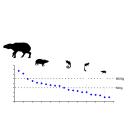
Des prospections géologiques et paléontologiques sur les affleurements continentaux paléogènes du Complexe de Gour Lazib (Hammada du Dra, Algérie) nous ont permis de mettre en évidence plusieurs sites à vertébrés, sur une superficie de plus de cinq cents kilomètres carrés. La faune est constituée de nombreux vertébrés fossiles associant mammifères placentaires, poissons actinoptérygiens et protoptères, squamates, amphibiens, chéloniens, crocodiles et oiseaux. La flore de charophytes est également diversifiée. Les données bio-magnétostratigraphiques indiquent un âge compris entre l’Yprésien terminal et le Lutétien basal pour cet assemblage unique en Afrique. Les nombreux restes de mammifères récoltés ont une préservation exceptionnelle pour le Paléogène ancien arabo-africain et permettent une reconstitution paléoenvironnementale réalisée via une méthode couplant cénogramme et distribution pondérale des taxons arboricoles. Le profil du cénogramme, caractérisé par l’abondance des espèces de petite taille (insectivores, primates et rongeurs), la présence d’espèces de taille intermédiaire (hyracoïdes) et la rareté des grandes espèces (uniquement représentées par les hyracoïdes ; absence notable des proboscidiens et embrithopodes), met en évidence un milieu forestier assez fermé sous climat tropical. Par ailleurs, les données lithologiques et sédimentologiques indiquent un milieu fluviatile méandriforme où ont proliféré les charophytes. Plus hypothétique reste l’existence d’une saisonnalité dans les Gour Lazib, avec de possibles périodes temporaires modérément arides.
PV article infos
Article state: in_press
|
PDF
S.I. Data
|
|
FIRST OCCURRENCE OF PAMPATHERIUM (XENARTHA: PAMPATHERIIDAE) FROM THE EL CEDAZO CREEK, AGUASCALIENTES, MEXICO
Published online: 01/01/1970
Keywords:
Aguascalientes; El Cedazo; Mexico; Pampatherium; Pleistocene
https://doi.org/10.18563/pv.49.2.e3
Abstract
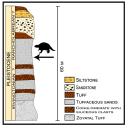
The glyptodontid Pampatherium is currently known from Pleistocene and Pliocene deposits in the State of Mexico, Puebla, Jalisco and Guanajuato. Recently, from the Late Pleistocene locality of El Cedazo creek (Aguascalientes), has revealed fragmentary remains assigned by its anatomical characteristics to the genus Pampatherium. The recovered specimen consists of an articulated anterior left fragment of the carapace comprising 78 osteoderms, which display the diagnostic ornamentation of the genus including a depressed central area, attenuated ornamentation, reduced or absent marginal band, as well as a general rectangular shape. These morphological characteristics clearly support assignment to the genus Pampatherium and distinguish the material from Holmesina, which has been previously reported from the El Cedazo Local Fauna. However, the absence of cranial or dental material and the potential influence of ontogenetic variation preclude a confident species-level identification. Accordingly, the specimen is referred to Pampatherium sp. This finding represents the first confirmed record of the genus in the state of Aguascalientes and provides new evidence of the presence of pampatheriids in the El Cedazo Local Fauna.
PV article infos
Article state: in_press
|
PDF
|