|
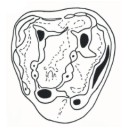
The beginning of the adaptive radiation of Theridomorpha (Rodentia) in Western Europe: morphological and phylogenetic analyses of early and middle Eocene taxa; implications for systematics
Published online: 20/09/2021
Keywords:
characters analyses; Dental morphology; Eocene; Rodentia; variability
https://doi.org/10.18563/pv.44.2.e2
Abstract
This paper provides a revision of the early and middle Eocene European rodents previously referred to as Ischyromyoidea, including taxa considered to be at the origin of the Theridomorpha. The use of an accurate dental terminology and a better understanding of the size and shape of their infra-orbital foramen (i.o.f.) led us to a substantial revision of this group, which allowed to better characterize them and to appreciate their variability. On these bases, phylogenetic analyses (cladistic and standard Bayesian
approaches) of early Ypresian to late Priabonian European rodent species were undertaken in order to highlight the root of the early Theridomorpha and its content. In this paper, the phylogeny was established based on 343 characters (338 dental) through 45 early Paleogene taxa using both cladistic and bayesian analyses. The ingroup included on one hand a few North American genera (Reithroparamys, Microparamys, and Acritoparamys) and European ones (Eogliravus, Ailuravus, Corbarimys, Meldimys, Euromys, Plesiarctomys, and Pseudoparamys) considered until now as being related with the North American superfamily Ischyromyoidea. On the other hand, it included genera close to the root of the Theridomorpha (Sparnacomys, Pantrogna, and Hartenbergeromys) and early Theridomyoidea (Masillamys, Protadelomys, and some Pseudosciuridae). The phylogenetic results obtained via the two
distinct reconstruction approaches are consistent in virtually all relationships. The proposed systematics here derives from these phylogenetic results. This phylogenetic context led us to change the suprafamilial, familial, subfamilial or generic attribution of several species. Characters of Theridomorpha, like the obliquely developed postprotocristid allied with the occurrence of a metalophulid I, have been found in genera previously considered as Ischyromyidae (Pseudoparamys, Euromys, Sparnacomys, Meldimys, Pantrogna, and Hartenbergeromys) as well as the large i.o.f., when preserved (Pseudoparamys, Hartenbergeromys, and Masillamys). Based on these morphological observations and new phylogenetic considerations, the content of the Theridomorpha clade is here enlarged, thereby extending back the first theridomorph radiations to the early Eocene. Aside, a new taxon (Reinomys rhomboides gen and sp. nov.) is described from Avenay. In addition, a new genus, Auroremys, is created for the species subita (Comte et al., 2012) from Chery-Chartreuve.
PV article infos
Published in 44-2 (2021)
|
PDF
S.I. Data
|
|
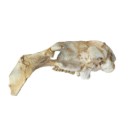
A partial skeleton of Metaxytherium medium from the middle Miocene of La Morfassière quarry (Indre-et-Loire, France)
Published online: 16/01/2025
Keywords:
Faluns; France; Metaxytherium; Miocene; Sirenia
https://doi.org/10.18563/pv.48.1.e1
Abstract
Sirenians are among the common marine fossil remains found in the Faluns deposits of western France. We describe new material of a Dugongidae sirenian from the middle Miocene Savignean facies of La Morfassière quarry (Indre-et-Loire, northwestern France) that includes a well preserved and almost complete skull associated with its mandible, several vertebrae and ribs. The cranial remains exhibit features that allow to attribute them to Metaxytherium medium, a species recorded from the middle and early late Miocene of European and Mediterranean coasts. The discovery of an associated skull and mandible of this species is unusual in this area and deserves to be reported, mostly because its preservation contributes to a better knowledge of the variable structure of its skull and teeth anatomy. For the first time the body size and weight of M. medium can be assessed through regression equations based on skull measurements. The particularly good condition of the material can be explained by the calm and deep marine environment in which it was deposited.
PV article infos
Published in 48-1 (2025)
|
PDF
|
|
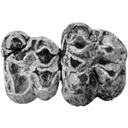
A new study of the anthracotheres (Mammalia, Artiodactyla) from pondaung formation, Myanmar: systematics implications
Published online: 16/12/2008
Keywords:
Anthracohyus; Anthracokeryx; Anthracotherium; Pondaung Formation; sexual dimorphism; Siamotherium; South East Asia; taxonomy
https://doi.org/10.18563/pv.36.1-4.89-157
Abstract
Anthracotheres from the Pondaung Formation, Myanmar, are considered as one of the most primitive artiodactyl groups and they represent the oldest known record in the world. Thus, the understanding of this group has numerous implications for evolutionary biology and biochronological correlations. However, the systematlcs of these mammals has been interpreted in different ways, and the main debate focuses on the number of taxa represented in the Pondaung Formation. The revised taxonomy proposed here is mainly based on the relative development of the upper molar W-shaped ectoloph, system of crests and stylar cusps, and on body size. On the basis of these characters, they are classified into four genera including six different species. Two well-known genera, Anthracotherium and Anthracokeryx, are validated and more precisely diagnosed. Anthracokeryx possesses a better developed W-shaped ectoloph, system of crests and stylar cusps than Anthracotherium, which displays notable differences with the more derived representatives of this genus. Both of these Pondaung genera show evidence for sexual dimorphism. However, the incompleteness of fossil material fueled a debate concerning the status of two additional Pondaung anthracotheres, Siamotherium and Anthracohyus. The latter genus is of uncertain affinities, but it has been considered as a hippopotamid ancestor. Despite new material attributed to these two forms, additional discoveries are still required to establish their taxonomic status. The hypothesis that Southeast Asia was the centre of origin of Anthracotheriidae is supported by the retention of numerous primitive dental characters in these taxa and by the antiquity of the Pondaung Formation, to which an age of 37 My is now generally accepted.
PV article infos
Published in Vol. 36, Fasc. 1-4 (2008)
|
PDF
|

|
The eosimiid and amphipithecid primates (Anthropoidea) from the Oligocene of the Bugti hills (Balochistan, Pakistan): new insight into early higher primate evolution in South Asia.
Published online: 15/10/2006
Keywords:
Amphipithecidae; anthropoid phylogney; Bugti Hills; Early Oligocene; Eosimiidae; Pakistan
https://doi.org/10.18563/pv.34.e15
Abstract
Eosimiid and amphipithecid primates document a long and significant history of primate evolution throughout the Eocene in Southeast Asia. Despite the absence of a comprehensive post-Eocene fossil record, it was generally hypothesized that both families left no descendant in Asia. Recently, two new small-bodied taxa, Bugtipithecus and Phileosimias, have been recovered in early Oligocene coastal deposits from the Bugti Hills (Balochistan, central Pakistan) and referred to the families Amphipithecidae and Eosimiidae, respectively, on the basis of dental fossil remains. In this paper, we provide more exhaustive description, comparison, and discussion of these taxa. As for tarsiid and sivaladapid primates, the persistence of eosimiids and amphipithecids into the Oligocene clearly demonstrates that low latitudes of South Asia provided a continuous access to tropical refugia during the climatic deterioration characterizing the late Eocene-early Oligocene interval, which was seemingly lethal for primate communities elsewhere across the Holarctic continents. As a contribution to the ongoing phylogenetic debates regarding the position of eosimiids and amphipithecids on the primate family tree, we have performed a cladistic analysis in a high-level primate systematic context in order to assess the position and the role of these new taxa in that phylogenetic issue. Our results support the view according to which eosimiids and amphipithecids (and by extension Phileosimias and Bugtipithecus, respectively) are stem anthropoids. These fossils from Pakistan document an unsuspected Oligocene phase of the evolutionary history of anthropoid primates in southern Asia, which clearly enhances the extent of the anthropoid radiation in this province during the Paleogene. Several phylogenetic and paleobiogeographic aspects are discussed, notably the intra- and inter-relationships between Paleogene Asian and Afro-Arabian anthropoids, and the resulting potential dispersal models between both land-masses during the Paleogene.
PV article infos
Published in Vol. 34, Fasc. 1-2 (2006)
|
PDF
|
|
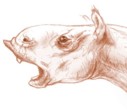
There were giants upon the earth in those days
Published online: 16/07/2014
Keywords:
Eurasia; history of science; Indricotheriinae; Paléogène; Rhinocerotoidea
https://doi.org/10.18563/pv.38.1.e4
Abstract
Rhinoceros Giants: the Paleobiology of Indricotheres. Donald R. Prothero. Life of the Past Collection, Indiana University Press; 160 pp. (66 b&w illustrations). Hardback (7x10”): USD 42.00 plus shipping. ISBN: 978-0-253-00819-0. E-book: USD 34.99. ISBN: 978-0-253-00826-8.
PV article infos
Published in Vol.38-1 (2014)
|
PDF
|

|
Introduction à l'oeuvre scientifique de Donald E. Russell, "gentleman paleontologist"
Published online: 16/12/1996
Keywords:
D.E.Russell; Eocene; Mammals; Paleocene; Paleontology; synthesis
https://doi.org/10.18563/pv.25.2-4.63-74
Abstract
The scientific career of D.E. Russell began with a Pliocene fauna from Oregon, and then turned in the direction of European Paleogene mammals. Field work followed by study of the mammals that were collected, firstly in the Paleocene and later in the early Eocene, greatly rejuvenated learning in this field. Syntheses on the Northwest European Tertiary basin and on European marnmals and stratigraphy came next. Research on the Eocene of Asia was carried out jointly with Gingerich on Pakistan and with Dashzeveg on the faunas of Mongolia. An important synthesis on the entire Paleogene of Asia, joint with Zhai, followed. Field work in Africa with Sigogneau-Russell led to the discovery of Mesozoic mammals there. A synthesis of mammalian paleofaunas of the world was written with Savage, and a similar synthesis of Cenozoic vertebrate faunas is currently being prepared. These achievements reflect the perennial importance of field work, numerous collaborations with both amateurs and professionals, and the human qualities of this author.
PV article infos
Published in Vol. 25, Fasc. 2-4 (1996)
|
PDF
|

|
Avant-propos
Published online: 16/12/1996
Keywords:
D.E.Russell
https://doi.org/10.18563/pv.25.2-4.61-62
Abstract
Le présent volume est l'aboutissement d'un projet né il y a presque cinq ans. En décembre 1991, l'un d'entre nous (MG) prenait des contacts en vue de proposer un symposium sur les mammifères fossiles, dédié à D.E. Russell, dans le programme du 4e Congrès de la European Society for Evolutionary Biology. Ce congrès, baptisé "Evolution 93", devait se tenir à Montpellier en août 1993. Son Comité d'Organisation, animé par F. Catzeflis, recherchait des organisateurs de symposiums. L'idée fut acceptée avec enthousiasme par le second d'entre nous (PDG), et le titre de notre Symposium fut précisé: " Palaeobiology and Evolution of Early Cenozoic Mammals - A Symposium in Honor of D.E. Russell". Le projet fut formellement accepté par le Comité d'Organisation en avril 1992.
PV article infos
Published in Vol. 25, Fasc. 2-4 (1996)
|
PDF
|

|
Contributions à l'étude des micromammifères du gisement Miocène supérieur de Montredon (Hérault). 3- Les insectivores
Published online: 30/06/1982
Keywords:
Hérault; Insectivora; Late Miocene; Micromammals; Montredon
https://doi.org/10.18563/pv.12.3.119-131
Abstract
This paper presents a preliminary list of insectivores from the Vallesian beds at Montredon (France). The associated rodent fauna has established a Vallesian age for the fauna. Eleven species belonging to the Soricidae, Talpidae, Erinaceidae, and Dimylidae are identified of which four only are referred with certainty to forms already named.
PV article infos
Published in Vol. 12, Fasc. 3 (1982)
|
PDF
|

|
Multituberculate endocranial casts
Published online: 30/06/1983
Keywords:
Allotheria; Cretaceous; endocranial cast; Mongolia; multituberculates
https://doi.org/10.18563/pv.13.1-2.1-12
Abstract
A reconstruction of a multituberculate endocranial cast is made on the basis of a complete natural cast prepared from the skull of Chulsanbaatar vulgaris, and other less complete endocasts, all from the Late Cretaceous of Mongolia. The multituberculate endocast is of mammalian pattern but it has retained a therapsid-like lateral profile with a deep rhombencephalon and a shallow telencephalon. It is characterized by: a heart-shaped cross-section of the telencephalon; an extensive lissencephalic neocortex; a very prominent pons placed far anteriorly; a lack of cerebellar hemispheres, and very large paraflocculi. Its structure, very different from the brains of other mammals, suggests thats the Multituberculata branched very early from the main mammalian stock. This supports Simpson's (1945) idea that the Multituberculata should be placed in a subclass of their own: Allotheria MARSH. The endocast and braincase structure show that the Multituberculata had strongly developed senses of smell and hearing. The encephalization quotient of approx. 0.55 evaluated for Ch. vulgaris is relatively high for a Mesozoic mammal.
PV article infos
Published in Vol. 13, Fasc. 1-2 (1983)
|
PDF
|

|
Systematic and evolutionary relationships of the hipparionine horses from Maragheh, Iran (Late Miocene, Turolian age)
Published online: 30/12/1985
Keywords:
evolution; Hipparionine horses; Iran; Systematics; Turolian
https://doi.org/10.18563/pv.15.4.173-269
Abstract
A systematic analysis of an hipparionine horse assemblage from Maragheh, Iran is made. A brief orientation to systematic philosophy and informal superspecific characterizations of some Old World hipparionines is given as a background to this work. A character state analysis of skulls is made, and has revealed five distinct species. A character state and stratigraphic trend analysis of isolated check tooth and postcranial remains, with known provenance, is also made. These two combined analyses reveal that the most resolute discrimination of hipparionine species and their evolutionary relationships occurs when multiple character complexes of associated skulls, maxillary and mandibular dentitions are made. When this is not possible, skulls have provided the best basis for discriminating species and their evolutionary relationships. Traditional characters of isolated cheek teeth and postcranial remains are shown here to offer limited information content for hipparionine phylogenetic systematics. The systematic portion of this study includes a comprehensive description of cranial and postcranial remains, and has further corroborated the distinction of five species which belong to at least three superspecific groups including: «Hipparion» geltyi sp. nov., Group 1; Hipparion prostylum (s. l.), and Hipparion campbelli sp. nov., Group 3; «Hipparíon» aff. moldavicum and «Hipparion» ?matthewi, Group 2. These species stratigraphic ranges and evolutionary relationships are also given here and argued to be important for establishing future hipparionine geochronologic correlations between a number of Eurasian late Miocene provinces.
PV article infos
Published in Vol. 15, Fasc. 4 (1985)
|
PDF
|

|
Analyse d'ouvrage : A.J.Sutcliffe. On the track of Ice Age mammals
Published online: 30/12/1985
Keywords:
Book review
https://doi.org/10.18563/pv.15.4.270
Abstract
On the Track of Ice Age Mammals justifie pleinement son titre car l'auteur, Anthony J. Sutcliffe, apporte au lecteur faits et interprétations qui l'amèneront à s'intéresser encore plus au passé récent et à l'avenir de son environnement et à la question de l'impact de l'homme sur la nature. Après les chapitres qui présentent les temps glaciaires et les divers témoignages qui nous en sont parvenus, les cinquième et sixième apportent les informations nécessaires à la compréhension des résultats que nous donnent les chercheurs: principes, moyens d'étude et limites des méthodes, difficultés de l'intégration des données dans un cadre stratigraphique, variabilité des signaux climatiques, variabilité de leur intensité selon l'endroit par rapport au centre de la glaciation, complications liées à la qualité inégale de l'enregistrement géologique, en mer et sur le continent.
PV article infos
Published in Vol. 15, Fasc. 4 (1985)
|
PDF
|

|
Un nouveau genre de ?Palaeotheriidae (Perissodactyla, Mammalia) décelé dans les phosphorites du Quercy (Eocène supérieur ou Oligocène) d'après un arrière crâne sans dents.
Published online: 15/06/1999
Keywords:
endocranial cast; Epitympanic sinus; Palaeotheriidae; Paléogène; Quercy Phosphorites; skull anatomy
https://doi.org/10.18563/pv.28.1.75-87
Abstract
A rear skull from the Quercy Phosphorites is described. It documents a new perissodactyl genus, likely assignable to the family Palaeotheriidae and probably paleogene of age. Owing to the lack of any tooth, this family assignment remains however somewhat hypothetical. The specimen is firstly characterised by the presence of a wide epitympanic sinus swelling and hollowing the squamosal shell and the post-glenoid process. This cavity might make up a peculiar pattern of improvement for the hearing apparatus by carrying out a kind of drum near the middle ear, whereas the bony tympanic remains barely bulged and forms but a few developed auditory bulla. This pattern appears an outcome of a trend observed with many palaeotheriids, such as Plagiolophus. Furthermore, the endocranial cast shows a rather high degree of gyrencephaly for a paleogene mammal. The prominent lambdoidal crest points out a powerful nape musculature and a lowered head bearing. Consequently, it is assumed that such an animal was probably living in somewhat open places, at the expense of rather tough vegetables. It might have been accordingly provided with a semi-hypsodont, cement covered, "plagiolophoid" dentition.
PV article infos
Published in Vol. 28, Fasc. 1 (1999)
|
PDF
|

|
Nouveaux gisements à rongeurs dans les molasses oligo-miocènes de la région toulousaine
Published online: 11/02/1993
Keywords:
Cricetidae; Eomyidae; GIiridae; Miocene; Oligocene; Rodents; Sciuridae; Southern France
https://doi.org/10.18563/pv.22.2-3.113-136
Abstract
The fauna from three new rodent localities (Castelmaurou, Grépiac-carrière et Grépiac-rive gauche) from Oligo-Miocene molasses of the Toulouse area is described. The one from Colomiers is completed. 11 species belonging to 4 families (Cricetidae, Eomyidae, Gliridae, Sciuridae) are present. The Miocene localities of Grépiac-carrière and Colomiers are correlated with Balizac, La Brète, Lambert and Lespignan. Grépiac-rive gauche is just a little older than these sites. Castelmaurou is somewhat younger than La Milloque and belongs to Oligocene.
PV article infos
Published in Vol. 22, Fasc. 2-3 (1993)
|
PDF
|

|
Analyse d'ouvrage: “J.J. THOMASON (Ed.): Functional morphology invertebrate paleontology (1995)”
Published online: 18/03/1996
Keywords:
Book review; Functional morphology
https://doi.org/10.18563/pv.25.1.54-55
Abstract
Functional morphology invertebrate paleontology, édité par Jeffrey J. THOMASON, 1995. Cambridge University Press, xi + 277 p. ISBN 0-521-44095-5, f. 45,00 ($ 69,95).
La morphologie fonctionnelle appliquée aux fossiles demeure un sujet à la fois passionnant et important. Passionnant, car elle s'adresse à des êtres disparus, aux combinaisons de caractères parfois inattendues et sans contrepartie chez les formes actuelles. Sujet important, car il faut, au delà de la constatation classique de l'adéquation de la forme des organes à leur fonction, expliquer l'origine des structures par évolution. L'évolution ou descendance avec modification, implique que les êtres vivants sont reliés les uns aux autres et qu'i! est possible de tenter à l'aide d'un raisonnement par inférence, la caractérisation des ancêtres en fonction des traits des formes auxquelles ils ont donné naissance. Mais il faut ajouter que par sa fonction, la structure relie immédiatement l'animal à son milieu puisqu'elle assure un rôle biologique.
PV article infos
Published in Vol. 25, Fasc. 1 (1996)
|
PDF
|

|
Les Entélodontes des phosphorites du quercy
Published online: 15/11/1974
Keywords:
Entelodontes; Quercy Phosphorites
https://doi.org/10.18563/pv.6.1-2.87-108
Abstract
The entelodonts of the Quercy phosphorites are essentially known from isolated teeth. The skull remains attributed to Entelodon magnum by Kowalewsky in 1876 and the type left mandible of Enteladon depereti RÉPELIN, 1918 do not belong to this family. From a morphologic point of view, the teeth from Quercy are quite comparable to those from the type localities of E. magnum and E. deguilhemi. In the absence of distinctive anatomical criteria between E. magnum (small species from the level of Ronzon) and E. deguilhemi (large species from the level of Villebramar) they are referred, according to their size, to one or the other of these two species. However, some of them are intermediate in size. Their existence speaks in favor of a close relationship between E. magnum and E. deguilhemi and confers a real stratigraphic interest to these entelodonts of Western Europe. Finally, some anatomical characters (notch on the mesial border of P4, presence of a paraconid joined to the metaconid, trigonid higher than talonid) considered until now as peculiar to the North American Archaeotherium and not yet cited in its European contemporary Entelodon have been brought to light on the teeth from Quercy.
PV article infos
Published in Vol. 06, Fasc. 1-2 (1974)
|
PDF
|

|
Sur le plus ancien Lagomorphe Européen et la "Grande Coupure" Oligocène de Stehlin
Published online: 01/01/1974
Keywords:
Grande Coupure; Lagomorphe; Oligocene
https://doi.org/10.18563/pv.6.3-4.243-251
Abstract
Pour la première fois un spécimen de lagomorphe a été récolté en Quercy. L'intérêt de ce fossile tient surtout à son âge géologique inattendu, qui recule considérablement la date de première apparition en Europe de cet ordre de mammifère, Ceci nous paraît justifier une nouvelle réflexion sur la « grande coupure» oligocène,
PV article infos
Published in Vol. 06, Fasc. 3-4 (1975)
|
PDF
|

|
Long-term fidelity of megaoolithid dinosaurs to a large breeding-ground in the Upper Cretaceous of Aix-en-Provence (southern France).
Published online: 15/12/2003
Keywords:
Large nesting ground; megaloolithid eggs; Southern France; Upper Cretaceous
https://doi.org/10.18563/pv.32.2-4.109-120
Abstract
We present here the preliminary results from a new nesting site "Sextius-Mirabeau", discovered close to the historical centre of Aix-en-Provence in Upper Cretaceous deposits. This extensive megaloolithid nesting ground, the first large scale excavation (3225 m²) in France, yielded more than 530 eggs, some organized in clusters. Their study reveals the reproductive strategy of the megaloolithid egglayer group which indicates nesting fidelity and gregarious behaviour.
PV article infos
Published in Vol. 32, Fasc. 2-4 (2003)
|
PDF
|

|
Rates of evolution in divergent species lineages as a test of character displacement in the fossil record : tooth size in Paleocene Plesiadapis (Mammalia, Proprimates)
Published online: 16/12/1996
Keywords:
character displacement; character divergence; fractal time series; Plesiadapis; Rates of evolution
https://doi.org/10.18563/pv.25.2-4.193-204
Abstract
Two species lineages of North American late Paleocene Plesiadapis exhibit a pattern of size divergence from a common ancestral lineage. Time series of fossils in each of these lineages are analyzed to test the idea that size divergence represents competitive character displacement. The critical factor in a test of character divergence is showing that divergent lineages evolved directionally rather than randomly (multifactorially). Analysis of evolutionary rates and their temporal scaling in Plesiadapis shows that both divergent species lineages have the scaling slope expected for lineages evolving randomly rather than directionally, and size divergence in Plesíadapis does not represent character displacement. Rates of evolution commonly observed on a per-generation time scale are high enough to produce character displacement within a few generations. Thus character displacement is not likely to be visible on scales of time that can be studied in the fossil record.
PV article infos
Published in Vol. 25, Fasc. 2-4 (1996)
|
PDF
|

|
Les Tayassuidés des phosphorites du Quercy
Published online: 15/11/1974
Keywords:
Quercy Phosphorites; Tayassuidae
https://doi.org/10.18563/pv.6.1-2.55-85
Abstract
Revision of the Tayassuidae from the old collections of the Quercy leads to interesting facts about taxonomic and phylogenetic problems. It could not have been well done without constant comparison with contemporaneous Tayassuidae from stratified series, as well as with European Miocene Tayassuidae and Hyotheriinae. The result is that only three species are present in the Phosphorites of Quercy: Doliochoerus quercyi FiLHOL (represented by two sub-species: the older, D. quercyi quercyi and the more recent, D. quercyi aquensis), Palaeochoerus gergorianus CROIZET et BLAINVILLE and Palaeochoerus purillus nov. sp. The two former species disappeared with Stampian time, while the third is the direct ancestor of the Aquitanian Palaeochoerus typus POMEL, which became extinct before the beginning of Burdigalian.
The comparison with Hyotheriinae brought to light new criteria for determinations, based on the study of lower premolars. These observations are condensed in a table of keys for determinations.
As a result of these studies, it came to light that the Suoidea of the Oligo-Miocene of Europe have never given rise to, except in rare cases, very long lineages. The different forms of pigs are replaced constantly in Europe by the simple game of extinctions and migrations. The reason of that discontinuity is considered here.
PV article infos
Published in Vol. 06, Fasc. 1-2 (1974)
|
PDF
|

|
Archosauriform teeth from the upper Triassic of Saint Nicolas-de-Port (Northeastern France).
Published online: 15/12/1997
Keywords:
Archosauriforms; Graoullyodon hacheti; Saint-Nicolas-de-port; Teeth; Upper Triassic
https://doi.org/10.18563/pv.26.1-4.1-34
Abstract
The Late Triassic locality of Saint-Nicolas-de-Port (Meurthe-et-Moselle, France) has yielded numerous isolated teeth belonging to archosauriform reptiles. The following tooth groups can be identified: heterodont phytosaurs, the pterosaur Eudimorphodon, the prosauropod dinosaur Plateosaurus, three types of putative ornithischian teeth and 13 types of carnivorous Archosauriformes indet. Apparent venom-conducting teeth belonging to a new taxon of ?Archosauriformes (Graoullyodon hacheti nov. gen. nov. sp.) are also described. From a palaeogeographical point of view, the ornithischian teeth from Saint-Nicolas-de-Port (if their attribution is confirmed) are the oldest fossils of this group in Europe. The biostratigraphic distribution of the tooth forms mostly suggests a Late Norian or Early Rhaetian (depending on current interpretations) age of the deposits, but do not provide more precisions than fossils previously described from the area. The dietary habits and, consequently, the palaeoecological relationships of the different vertebrate groups discovered at Saint-Nicolas-de-Port are tentatively established: the ornithischian and prosauropod teeth reflect a herbivorous diet, whereas the other archosauriform teeth are probably from camivores or omnivores.
PV article infos
Published in Vol. 26, Fasc. 1-4 (1997)
|
PDF
|