

Abstract book of the 18th Conference of the EAVP
Miocene Bovidae (Mammalia) of the Siwaliks: Hypsodontinae and Bovinae
Pterosaurs from Coahuila
Les sélaciens du Miocène de la région de Montpellier
Contribution à l'étude des genres Gliravus et Microparamys.
Muridae du Pliocène supérieur d'Espagne et du midi de la France.
Eocene (57) , Quercy Phosphorites (38) , Systematics (32) , Rodents (29) , Mammalia (27) , Rodentia (25) , Miocene (25)
Page 12 of 19, showing 20 record(s) out of 368 total

|
|
|

|
The fossil rabbit from Valdemino cave (Borgio Verezzi,Savona) in the context of western Europe Oryctolagini of Quaternary.Giulia Nocchi and Benedetto SalaPublished online: 15/12/1997Keywords: Lagomorpha; Mammals; North-western Italy; Oryctolagus; Plio-Pleistocene; Savona https://doi.org/10.18563/pv.26.1-4.167-187 Abstract The present research deals with the remains of a lagomorph found at Valdemino cave and comes to the conclusion that it is a rabbit with peculiar characteristics in comparison with the other known species Oryctolagus laynensis, O. lacosti and 0. cuniculus. We studied other fossil remains of rabbit populations from Villafranchían and middle Pleistocene deposits and compared them with data from the literature and with recent material. The analysis leads us to maintain two phylogenetic hypotheses about the history of Oryctolagini. The ñrst one, already formulated by Lopez Martinez, suggests that 0. cuniculus derives from O. laynensis,while the origin of O. lacostí is unknown; according to the second hypothesis 0. laynensis would be the common ancestor of two phyletic lineages, 0. lacosti and 0. cuniculus. In both cases the lagomorph from Valdemino would be the form derived from 0. lacosti, from which however it differs in peculiar characteristics. Since the rabbit from Valdemino survives until the beginning of Postgalerian, its disappearance may coincide with the retreat of 0. cuniculus from western Europe in Spain and, perhaps, in south-western France, before the last glaciation. O. cuniculus survived in Spain, from where it spread once again over western Europe as a result of man. PV article infos Published in Vol. 26, Fasc. 1-4 (1997) |
|

|
Révision des Artiodactyles de l'Eocène moyen de Lissieu (Rhône)Jean SudrePublished online: 15/05/1972Keywords: Artiodactyles; Dichodon; France https://doi.org/10.18563/pv.5.4.111-156 Abstract The object of this work is the study of the artiodactyls of the karstic locality of Lissieu near Lyon. Among the sixteen species counted, five (Hyperdichobune nobilis, Hyperdichobune sp., Haplabunodon mulleri, Tapirulus depereti and Pseudamphimeryx schlosseri) are cited for the first time in this fauna. The description of part of the anterior dentition of «Dichobune» langi permits the referal of this species to the genus Hyperdichobune. The new selenodont species Dichodon lugdunensis described in this work belongs, with its ancestor Dichodon simplex, to a lineage distinct from that of Dichodan cartieri and Dichodon ruetimeyeri. Finally, the taxonomic reality of the Lissieu species, Lophiobunodon rhodanicum Deperet, is justified. All the other species have been compared with those of Egerkingen. Even though with most of them no difference in age can be shown between the two deposits, some however indicate clearly by their degree of evolution that Lissieu is slightly more recent than Egerkingen. ln the history of Eocene mammals, the Lissieu fauna, because of its homogeneity, can be considered as a sure reference fauna of the Auversian period. PV article infos Published in Vol. 05, Fasc. 4 (1972) |
|

|
Les Entélodontes des phosphorites du quercyMichel Brunet
Published online: 15/11/1974 |
|

|
Nouveaux gisements à rongeurs dans les molasses oligo-miocènes de la région toulousaineFrancis Duranthon
Published online: 11/02/1993 |
|

|
Premier signalement du Monachinae (Phocidae, Mammalia) dans le Sahélien (Miocène supérieur) d'Oran (Algérie)Christian de Muizon
Published online: 15/10/1981 |
|

|
Rongeurs du Miocène inférieur et moyen en Languedoc. Leur apport pour les correlations Marin-Continental et la Stratigraphie.Jean-Pierre AguilarPublished online: 31/03/1980Keywords: Languedoc; Miocene; Rodents; Southern France https://doi.org/10.18563/pv.9.6.155-203 Abstract The rodents (Cricetidae, Gliridae, Sciuridae) found in lacustrine, brackish marine and karstic sediments of Miocene age in Languedoc, assign the position of the different localities in the scale of "niveaux repères" used by mammalogists. Some detailed stratigraphical studies bring several correlations between this continental biochronological scale and the marine scale ; the most important results are the Aquitanian age of the "niveaux repères" of Coderet and Paulhiac, the Burdigalian age of Laugnac, Estrepouy, Vieux-Collonges, La Romieu and Sansan and the Langhian or Lower Serravallian age of La Grive M. The correlations between the Tethys and the Central Paratethys for the Lower Neogene profit also of these results, since the locality of Neudorf Spalte 1, 2 (Czechoslovakia) is shown to be younger than Sansan (France). The paleontological study has also several geological inferences for the Miocene of Languedoc ; with the calibration of this Miocene, we know quite precisely that the Lower Miocene is chiefly a time lacustrine sedimentation, and also that the marine Miocene sedimentation ends early in the Miocene Period, in Langhian or lower Serravallian times. PV article infos Published in Vol. 09, Fasc. 6 (1980) |
|

|
Contribution à la classification des pistes de vertébrés du Trias: Les types du Stormberg d'Afrique du Sud (1).Paul EllenbergerPublished online: 16/10/1972Keywords: Footprints; South Africa; Stormberg; Trias https://doi.org/10.18563/pv.5.ext Abstract Cet article explore les pistes fossiles de vertébrés du Stormberg (Trias, Afrique du Sud), révélant une diversité ichnologique inédite avec 64 ichnotypes classés en tridactyles, tétradactyles et pentadactyles. Les découvertes incluent des reptiles bipèdes comme Qemetrisauropus et Prototrisauropus, dont les empreintes suggèrent des adaptations évolutives vers la bipédie, ainsi que des pentadactyles géants comme Pentasauropus, annonçant les futurs sauropodes. L’étude combine ichnologie et restes osseux pour reconstituer des écosystèmes triasiques riches, où flore (fougères, conifères) et faune témoignent d’une transition écologique majeure avant l’essor des dinosaures. PV article infos Published in Vol. 5, Ext (1972) |
|

|
Neue Beobachtungen zum Schädel-und Gebiss-Bau der Paulchoffatiidae (Multituberculata,Ober-Jura).Gerhard HahnPublished online: 15/12/1987Keywords: Dentition; Paulchoffatiidae; Portugal; Skull structure; Upper Jurassic https://doi.org/10.18563/pv.17.4.155-196 Abstract The ventral face of the Paulchoffatiinae skull (Multituberculata, Lower Kimmeridgian, Portugal) is new reconstructed. Some details hitherto unknown are added, as the presence of jugals, the structure of the palatine and the extension of the pterygoids. The situation of the m2/ is discussed. Kielanodon hopsoni n. g., n. sp. is erected, known by its upper p3-5/. From Guimarotodon leiriensis the mandible with its dentition is made known. New informations concerning the milk-dentition and the replacement of teeth are also added. PV article infos Published in Vol. 17, Fasc. 4 (1987) |
|

|
La morphologie dentaire des Thalattosuchia (Crocodylia, Mesosuchia).Patrick Vignaud
Published online: 15/12/1997 |
|

|
Evolution de la lignée Megacricetodon collongensis-Megacricetotodon roussillonensis (Cricetidae, Rodentia, mammalia) au cours du Midocène inférieur et moyen dans le Sud de la France.Jean-Pierre AguilarPublished online: 14/06/1995Keywords: Cricetids rodents; Evolutionary lineage; Lower and Middle Miocene; Mammalian biochronology; Megacricetodon new species; Southern France https://doi.org/10.18563/pv.24.1-2.1-45 Abstract New populations of the genus Megacricetodon have recently been discovered in Southern France.Two new species are defined: M. lemartineli n. sp. and M. fournasi n. sp., their stages of evolution are intermediate between those of M. gersii and M. roussillonensis. Morphological and biometrical analysis indicate the presence of only one lineage: M. collongensis--M. collongensis-gersii--M. gersii--M.lemartineli nov. sp.--M. fournasi nov. sp. and M. roussillonensis. This observation allows to refine the chronology based on rodents, for the Late Early Miocene and the Middle Miocene in the Southern France. PV article infos Published in Vol. 24, Fasc. 1-2 (1995) |
|

|
Rana (Amphibia : Ranidae) from the upper eocene (MP17a) Hordle Cliff locality, Hampshire, England.Alan J. Holman and David L. HarrisonPublished online: 15/06/1999Keywords: Amphibia; England; Rana; Ranidae; Upper Eocene https://doi.org/10.18563/pv.28.1.47-51 Abstract An ilium from the Upper Eocene (MP l7a) of Hordle, England, represents the first report of Rana from the Eocene of Britain. The ilium is similar to those of the water frog (Rana [ridibunda]) species group. PV article infos Published in Vol. 28, Fasc. 1 (1999) |
|

|
La poche à phosphate de Ste-Néboule (Lot) et sa faune de vertébres du Ludien Supérieur. Résumé.Bernard Gèze, Jean-Claude Rage
Published online: 15/09/1978 |
|

|
Contributions à l'étude du gisement Miocène supérieur de Montredon (Hérault). Les grands mammifères. 1 - Les LagomorphesNieves Lopez-MartinezPublished online: 15/11/1988Keywords: Lagomorpha; Montredon; Prolagus; Upper Miocene https://doi.org/10.18563/pv.18.ext.3-14 Abstract A sample of 231 isolated teeth of lagomorphs from the upper Miocene of Montredon (southern France), identified as the ochotonid Prolagus crusafonii DOPEZ, 1975, is studied, comparing it with other populations of the same species as well as with its closest species P. oeningensis (KÖNIG, 1825). PV article infos Published in Vol. 18, Ext (1988) |
|

|
Paleobiology of Messel ErinaceomorphsGerhard StorchPublished online: 16/12/1996Keywords: Erinaceomorpha; Germany; Grube Messel; Lipotyphla; Middle Eocene; Paleobiology https://doi.org/10.18563/pv.25.2-4.215-224 Abstract Three erinaceomorph species are known from the early Middle Eocene of Grube Messel near Darmstadt, Germany, which are referred to the family Amphilemuridae. Pholidocercus hassiacus, Macrocranion tupaiodon, and Macrocranion tenerum showed extraordinary adaptations to their different life strategies, and several of their specializations are unknown among living insectivores. Pholídocercus was a well-defended robust animal with an opportunistic feeding strategy. Macrocraníon zupaiodon was a slender forest floor-dweller with saltatorial specializations to escape from predators; fishes were the preferred component of its omnivorous diet. Macrocranion tenerum exhibited a combination of both survival strategies, extremely elongated hind limbs for rapid and even ricochetal flight and a spiny exterior as an effective protective device; it was probably specialized for feeding on ants. Thus, closely related, omnivorous-insectivorous forest floor-dwellers could exploit the Messel ecosystem. PV article infos Published in Vol. 25, Fasc. 2-4 (1996) |
|

|
Diversity of triconodont mammals from the early Cretaceous of North Africa-affinities of the AmphilestidsDenise Sigogneau-RussellPublished online: 15/10/2003Keywords: amphilestines; Early Cretaceous; gobiconodontines; North Africa; Teeth; triconodonts https://doi.org/10.18563/pv.32.1 Abstract The mammalian fauna (represented only by isolated teeth) from the early Cretaceous of Morocco includes a number of non-'therian' specimens, characterized by the antero-posterior alignement of the main molar cusps. This assemblage is very heterogenous, including forms (among them Gobiconodon palaios sp. nov.) that can be related to Laurasian triconodonts and several forms so far known only in this part of Gondwana (among them Kryptotherium polysphenos gen. et sp. nov.). The latter, in particular, exemplifies the diversity of the mammalian dental morphology in the Mesozoic, often largely underestimated. In the last part of this paper, the 'therian' affinity of the 'amphilestids' is discussed, on the basis of the arrangement of molar cusps, the interlocking mechanism and the occlusal pattem. PV article infos Published in Vol. 32, Fasc. 1 (2003) |
|

|
Morphotypes dentaires actuels et fossiles des Chiroptères Vespertilioninés. 1e partie: Etude des morphologies dentairesHenri MenuPublished online: 30/09/1985Keywords: bats; Dental morphology; fossils; PHYLOGENY; recent; Systematics https://doi.org/10.18563/pv.15.2.71-128 Abstract The classifications of the recent vespertilionine bats were made wihtout taking in account the teeth morphology; this resulted in a reduction of the possibilities of comparison with the available fossils. The generalized use of dental formulae was abusive: this contributed to the admission of artificial genera. These conditions have long delayed the consideration of characters able to frame the phylogeny of the sub-family. In the first part of the study, the teeth morphologies are described and analysed. morphological reference types are established for each upper and lower tooth: they should make an easier elaboration of criteria for the differentiation at generic level. The position of the species in view of these criteria allows one to group them into homogeneous genera, and to appreciate the degree of relationship that the latter have between them. The second part of the study (next publicationà will develop inferences dealing with systematics and phylogeny PV article infos Published in Vol. 15, Fasc. 2 (1985) |
|

|
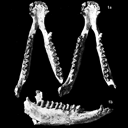
Rongeurs nouveaux de l'Oligocène Moyen d'Espagne.Louis ThalerPublished online: 15/09/1969Keywords: Cricetidae; Oligocene; Pseudocricetodon; Rodents; Theridomys https://doi.org/10.18563/pv.2.5.191-207 Abstract Description of four new rodents from a recently discovered locality at Montalban. Theridomys crusafonti nov. sp. is considered as the ancestry of T. Iembronicus. Theridomys varian: nov. sp. includes «Theridomys» morphotypes and «Blainvilllimys» morphotypes; it could be ancestral to B. blainvillei. Pseudoltinomys nanus nov. sp. represents a new lineage paralleling in evolution that of P. gaillardi (which is equally found at Montalban). Pseudocricetodon montalbanensis nov. gen., nov. sp. designates a lineage of very small Cricetidae accompanying Eucricetodon. With these well defined new species and six others present in the locality, Montalban appears as the best faunal reference point within the biochronologic zone of La Sauvetat. PV article infos Published in Vol. 02, Fasc. 5 (1969) |
|
|
Les Palaeotheridae (Perissodactyla) de la faune de Mammifères de Fons 1 (Eocène supérieur).Jean-Albert RemyPublished online: 15/06/1967Keywords: Anchilophus; Eocene; Pachynolophus; Palaeotheriidae; Perissodactyla https://doi.org/10.18563/pv.1.1.1-46 Abstract The locality of Fons 1, one of the fossiliferous outcrops in the late Eocene limestones of Fons-outre-Gardon (Gard), has yielded varied remains of mammals. The specimens were prepared by dilute acetic acid attack on the rock and by impregnation with an acrylic resin. PV article infos Published in Vol. 01, Fasc. 1 (1967) |
|

|
Relations phylétiques de Bachitherium filhol, ruminant de l'Oligocène d'Europe Occidentale.Denis Geraads
Published online: 20/06/1987 |
|
