|
Première occurrence d'un mégachiroptère ptéropodidé dans le Miocène moyen d'Europe (Gisement de Lo Fournas-II, Pyrénées-Orientales, France).
Published online: 31/10/1986
Keywords:
Europe; First occurence; Megachiroptera; Middle Miocene; Teeth
https://doi.org/10.18563/pv.16.3.173-184
Abstract
A lot of isolated teeth of a pteropodid fruit bat has been recently found within an assemblage of micromammals recovered from a karstic fissure filling named Lo Fournas-Il near the locality of Baixas (Pyrénées-Orientales, France). The fauna is Middle Miocene Serravallian age. The fossil fruit bat appears morphologically close to Rousettus; its size is that of a recent medium-sized fruit bat. While the fruit bats are very poorly known as fossils, this discovery shows that one of their recent types of dentitions was perfectly established by Middle Miocene times, and supports the presumed long geologic story of the suborder. One of the major invasions of the Old World fruit bats, supposed originated from SE Asia, reached up to Europe. A suborder unit is added to the miocene fauna of this continent.
PV article infos
Published in Vol. 16, Fasc. 3 (1986)
|
PDF
|

|
Ein neuer condylarthre und ein tillodontier (Mammalia) aus dem Mitteleozän des Geiseltales.
Published online: 15/04/1986
Keywords:
Condylarthra; Eocene; Europe; Mammalia; taxonomy; Tillodontia
https://doi.org/10.18563/pv.16.1.35-53
Abstract
In the course of a revision of the Equoidea numerous dentitions as well as a partial skeleton of a Phenaeodont were discovered from the Middle Eocene lignite beds of the Geiseltal locality. These fossils are recognized as a new genus and species of Phenacodontidae : HaIlensia matthesi n.g. n.sp.. The species is present in the « untere und obere Unterkohle ›› (uUK, oUK = the lower and upper part of the Lower Coal Seam) as well as in the « obere Mittelkohle ›› (oMK = the upper part of the Middle Coal Seam). Two fragmentary upper jaws described and figured by Matthes (1977) as Propachynolophus gaudryi are also belonging to Hallensia matthesi. Thus the decisive argument for classifying the " Unterkohle " of the Geiseltal section as Lower Eocene has to be dropped. Another relict form of the Geiseltal is Esthonyx tardus n. sp. documented by a fragmentary mandible coming from the « untere Unterkohle ››. This is the latest Tillodont from Europe. Contrasting to E. munieri from the european Lower Eocene the dentition of E. tardus is morphologically more progressive.
PV article infos
Published in Vol. 16, Fasc. 1 (1986)
|
PDF
|

|
Nouvelles données sur les mammifères du Thanétien et de l'Yprésien du bassin d'Ouarzazate (Maroc) et leur contexte stratigraphique.
Published online: 15/12/1998
Keywords:
early Paleogene; magnetostratigraphy; Mammals; Morocco; North Africa; Ouarzazatz basin; Systematics
https://doi.org/10.18563/pv.27.3-4.155-202
Abstract
New faunal and stratigraphical data on the vertebrates localities from the early Paleogene of the Ouarzazate Basin (Adrar Mgorn 1, Adrar Mgorn 1 bis et N'Tagourt 2), Morocco, are presented. A magnetostratigraphical study, the first for such early Paleogene Arabo-African mammal localities, and the discovery of probable remains of the nannofossil Discoaster support the Thanetian age of the Adrar Mgorn 1 site. The magnetostratigraphy suggests a slightly later age than was thought for the Paleogene formations of the local series of Tinerhir and for the vertebrate localities: late or latest Thanetian for Adrar Mgorn 1 and Adrar Mgorn 1 bis, middle Ypresian for N'Tagourt 2. It also indicates a lower position of the KT boundary in the series. Two tons of matrix recovered in the vertebrate sites have vielded new data on the micromammals. A damaged lower molar from N'Tagourt 2 is referable to Khamsaconus bulbosus and supports the proboscidean affinities of this species and especially possible relationships with bunolophodont taxa such as elephantiforms. A lower molar from Adrar Mgorn 1 bis belongs to a new form which can be identified as a plesiadapiform or an euprimate close to Altiatlasius koulchii though significantly larger. A new material from Adrar Mgorn 1 illustrates a new dilambdodont adapisoriculid species which is referable to Garatherium : ?Garatherium todrae n. sp. Another species referred to Garatherium is known in the locality (?Garatherium n. sp.). Garatherium is a new lineage from the Ouarzazate basin which crosses the Paleocene-Eocene boundary together with Palaeoryctes, Didelphodontinae gen. and sp. 2, Todralestes, and Afrodon, and it is the first Paleocene-Eocene lineage identified outside of this basin (Garatheríum is based on a species from El Kohol, Algeria). Among the Paleocene-Eocene lineages from the Ouarzazate basin, it should be also mentioned a new possible carnassial form (carnivoran or creodont; Adrar Mgorn 1), and an upper molar of Cimolestes cf. incisus (Adrar Mgorn 1 bis). The upper molar THR 168 previously reported as from an indeterminate didelphodontine is here identified as the M1/ of Afrodon chleuhi. The micromammal faunas from the Ouarzazate basin are positioned in the global chronological framework of the mammal localities from the Paleogene of the Arabo-African domain.
PV article infos
Published in Vol. 27, Fasc. 3-4 (1998)
|
PDF
|

|
Une nouvelle espèce de Steneosaurus (Thalattosuchia, Teleosauridae) dans le Callovien du Poitou (France) et la systématique des Steneosaurus longirostres du Jurassique moyen d'Europe Occidentale.
Published online: 15/09/1998
Keywords:
middle Jurassic; nov. sp.; phylogenetic relationships; skulls; Steneosaurus pictaviensis; Systematics; thalattosuchian crocodile
https://doi.org/10.18563/pv.27.1-2.19-44
Abstract
The study of all the available skulls allows us to review the systematic relationships of the longirostrine Steneosaurus from the Middle Jurassic of western Europe. Up to now, Aalenian and Bajocian deposits have not yielded any significant Steneosaurus remain. In the Bathonian, the only valid longirostrine species, S. megistorhynchus, is known in the Britain-Normandy Basin, the Poitou and the Lorraine. In the Callovian, most of the longirostrine Steneosaurus remains can be attributed to the species S. leedsi. Nevertheless, some remains from the Middle Callovian of Poitou (France) show important differences with S. leedsi. A new Steneosaurus species, only known in Poitou, is created and named S. pictaviensis. The specific characters are carried by the skull (preorbital pit well marked, orbit and ptetygoid fossae shapes), by the mandible (symphysis shape) and by the teeth (ornamentation). S. megistorhynchus is probably situated near the stem of the Callovian species but remains from the Bathonian and Lower Callovian are very scarce and it is very difficult to precise the phylogenetic relationships between the longirostrine species of the Middle Jurassic.
PV article infos
Published in Vol. 27, Fasc. 1-2 (1998)
|
PDF
|

|
Experimental taphonomy inavian eggs and eggshells: effects on early diagenesis.
Published online: 15/12/2003
Keywords:
archosaurian eggshells; avian egg; Experimental taphonomy; geochemical analysis; pyritisation; Upper Cretaceous
https://doi.org/10.18563/pv.32.2-4.77-95
Abstract
We experimentally explore the early taphonomic stages involving the decay and biodegradation of buried eggs and eggshells. Unfertilised commercial chicken eggs and eggshell fragments were buried in plastic containers and were kept under controlled conditions for eight months. Half of the containers were filled with marl, and the remainder with sand. All were saturated with fresh tap water, acidified water, sulphate water, or seawater. They were kept in the dark at 23.4-26 °C, except one, which was kept in a heating chamber at 37.4°C. We expected that different burial conditions would produce distinct taphonomic outcomes. Instead, the taphonomic alterations of buried eggs parallel that of the alteration of egg proteins (i.e., denaturation and/or putrefaction) with an additional role played by the eggshell. Mummification, encrustation, distortion and fragmentation, and necrokynesis (vertical displacement) depend on organic matter decay. The experiment identifies environmental conditions that may favour or actively promote these taphonomic processes. Of these, early pyritization is one of the most relevant. For comparative purposes, samples of fossil and extinct eggshell representing three distinct environmental burial conditions were examined. These included Megaloolithus, Caiman crocodilus, and Struthio camelus ootypes. The geochemical analysis of these eggshells showed no significant differences among the chemical variables of these fossil and extant ootypes. Eggshells exhibited a stable composition over a range of experimental conditions.
PV article infos
Published in Vol. 32, Fasc. 2-4 (2003)
|
PDF
|

|
Neolicaphrium recens Frenguelli,1921,the only surviving proterotheriidae (Litopterna, Mammalia) into the south american Pleistocene.
Published online: 30/07/2001
Keywords:
Litopterna; Neolicaphrium recens; Pleistocene; Proterotheriidae; South America
https://doi.org/10.18563/pv.30.1-2.37-50
Abstract
The litoptem Proterotheriidae are extinct endemic South American ungulates frequently used as an example of evolutionary convergence with the horses. They were considered to be exclusively Tertiary representatives with the youngest record being in the late Pliocene, before the appearence of the equids and cervids during the Great American Interchange. Two undoubted Pleistocene records in Argentina and the specimen here described from Uruguay, confirm the persistence of the proterotherids into that period. In the Quaternary, these ungulates are found outside the typical pampean region and probably were confined to a few northern and warmer more forested relictual microhabitats.
PV article infos
Published in Vol. 30, Fasc. 1-2 (2001)
|
PDF
|

|
Fossil mammals and the age of the changxindian formation, Northeastern China
Published online: 16/12/1996
Keywords:
Changxindian Formation; China; Eocene; Fossil mammals
https://doi.org/10.18563/pv.25.2-4.133-140
Abstract
Re-evaluation of the small collection of mammal fossils from the Changxindian Formation near Beijing, China indicates the following taxa are present: Eutheria, Hypsimilus beifingensis, cf. Miacis sp., Anthracotheriidae and Forstercooperia grandis. The presence of Forstercooperia grandis indicates an Irdinmanhan age and does not support previous assignment of a Sharamurunian age to the Changxindian Formation.
PV article infos
Published in Vol. 25, Fasc. 2-4 (1996)
|
PDF
|

|
Perutherium altiplanense, un Notongulé du Cretacé Supérieur du Pérou
Published online: 30/11/1983
Keywords:
Dental morphology; Late Cretaceous; Notoungulate; Paleobiogeography; Peru
https://doi.org/10.18563/pv.13.4.145-155
Abstract
Perutherium altiplanerise THALER, 1967 from the Late Cretaceous of Peru has long been recognized as South America's oldest known placental mammal. Since its description Perutherium has been generally regarded as having condylarth affinity Based on our identification of a unique notoungulate synapomorphy we recognize Perutherium as the oldest and the most generalized known member of that order. This new determination and the large taxonomic diversity (five families) of notoungulates in rocks of Paleocene age in Argentina and Brazil, favor a South American origin for this group. The occurrence of notoungulates in rocks of Late Paleocene age in Asia and North America is explained by dispersal of a notoungulate stock from South America to North America and from there to Asia.
PV article infos
Published in Vol. 13, Fasc. 4 (1983)
|
PDF
|

|
Nouveaux Mammifères Eocènes du Sahara Occidental
Published online: 01/11/1979
Keywords:
Eocene; Mammals; Occidental Sahara
https://doi.org/10.18563/pv.9.3.83-115
Abstract
The fossil mammals collected from the Eocene of Hammada du Dra (northwest Sahara. Algeria) and two fragmentary teeth from the Lutetian of M'Bodione Dadere (Senegal) are described.
The fossils from the northwest Sahara come from a lacustrian deposit dated by charophytes (Raskyella aff. pecki, Raskyella n. sp.. Maedleriella lavocati, Maedleriella sp. et ? Peckichara sp.) as Middle Eocene or perhaps Lower Eocene (Gevin, Feist and Mongereau, 1974). Several hyracoids (3 or 4) identified from this formation extends the age of the family Pliohyracidae Osborn in Africa. Three forms appear to belong in the genera Megalohyrax, Titanohyrax and perhaps Bunohyrax which have been know until now only from the lower Oligocene of the Fayum (M. gevini n. sp. ; T. mongereaui n. sp.. ? Bunohyrax or Megalohyrax indet.). Another hyracoidof small size is referred to a new genus, Microhyrax (M. lavocati n. sp.).
Helioseus insolitus n. g. n. sp. is described without ordinal assignment. Azibius (Sudre, 1975) which has been the subject of questions and interpretations is reviewed.
Only one tooth from the Lutetian of M'Bodione Dadere is complete enough to interpret. lt probably belongs to a condylarth and demonstrates for the first time, the presence of the order in Africa. The second tooth is too fragmentary for comment.
In conclusion., the paleobiogeographic role of Africa at the end of the cretaceous and the beginning of the Cenozoic is discussed.
PV article infos
Published in Vol. 09, Fasc. 3 (1979)
|
PDF
|

|
The eosimiid and amphipithecid primates (Anthropoidea) from the Oligocene of the Bugti hills (Balochistan, Pakistan): new insight into early higher primate evolution in South Asia.
Published online: 15/10/2006
Keywords:
Amphipithecidae; anthropoid phylogney; Bugti Hills; Early Oligocene; Eosimiidae; Pakistan
https://doi.org/10.18563/pv.34.e15
Abstract
Eosimiid and amphipithecid primates document a long and significant history of primate evolution throughout the Eocene in Southeast Asia. Despite the absence of a comprehensive post-Eocene fossil record, it was generally hypothesized that both families left no descendant in Asia. Recently, two new small-bodied taxa, Bugtipithecus and Phileosimias, have been recovered in early Oligocene coastal deposits from the Bugti Hills (Balochistan, central Pakistan) and referred to the families Amphipithecidae and Eosimiidae, respectively, on the basis of dental fossil remains. In this paper, we provide more exhaustive description, comparison, and discussion of these taxa. As for tarsiid and sivaladapid primates, the persistence of eosimiids and amphipithecids into the Oligocene clearly demonstrates that low latitudes of South Asia provided a continuous access to tropical refugia during the climatic deterioration characterizing the late Eocene-early Oligocene interval, which was seemingly lethal for primate communities elsewhere across the Holarctic continents. As a contribution to the ongoing phylogenetic debates regarding the position of eosimiids and amphipithecids on the primate family tree, we have performed a cladistic analysis in a high-level primate systematic context in order to assess the position and the role of these new taxa in that phylogenetic issue. Our results support the view according to which eosimiids and amphipithecids (and by extension Phileosimias and Bugtipithecus, respectively) are stem anthropoids. These fossils from Pakistan document an unsuspected Oligocene phase of the evolutionary history of anthropoid primates in southern Asia, which clearly enhances the extent of the anthropoid radiation in this province during the Paleogene. Several phylogenetic and paleobiogeographic aspects are discussed, notably the intra- and inter-relationships between Paleogene Asian and Afro-Arabian anthropoids, and the resulting potential dispersal models between both land-masses during the Paleogene.
PV article infos
Published in Vol. 34, Fasc. 1-2 (2006)
|
PDF
|

|
Henri Menu, 1925-2007
Published online: 16/12/2008
Keywords:
bats; biography
https://doi.org/10.18563/pv.36.1-4.1-5
Abstract
Record of life and works of Henri Menu, French zoologist, contributor to the knowledge of living and fossil bats.
PV article infos
Published in Vol. 36, Fasc. 1-4 (2008)
|
PDF
|
|
The digital endocast of Necrolemur antiquus
Published online: 24/07/2020
Keywords:
brain evolution; Eocene; Omomyiforms; Primates
https://doi.org/10.18563/pv.43.2.e1
Abstract
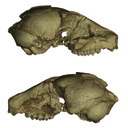
The study of endocasts, or casts of the endocranial space, have played an important role in shaping understanding of mammalian, and particularly primate, brain evolution. Recently, the reconstructions of three-dimensional virtual endocasts from high-resolution computed tomography images have allowed for the visualization and quantification of endocasts in several Paleocene and Eocene primate species. Here we present the virtual endocast of MaPhQ 289 (informally known as the Montauban 9 skull), a specimen of Necrolemur antiquus Filhol 1873, a middle to late Eocene European primate of the family Microchoeridae. The virtual endocast of MaPhQ 289 reveals a lissencephalic surface morphology with expanded temporal poles and minimal overlap of the cerebellum or olfactory bulb by the cerebrum, which closely resembles the morphology of the endocast of its contemporary relative, Microchoerus erinaceus (Primates, Microchoeridae). MaPhQ 289 yields an endocranial volume (ECV) of 2.36 cm3, about 60% smaller than the volume of the most commonly cited ECV of N. antiquus. Thus, the size of the brain of N. antiquus relative to its body size is likely to be smaller than has been reported in previous literature, highlighting the importance of corroborating older ECV estimates with new evidence using 3-D imaging techniques.
PV article infos
Published in 43-2 (2020)
|
PDF
|
|
A new species of hippopotamine (Cetartiodactyla, Hippopotamidae) from the late Miocene Baynunah Formation, Abu Dhabi, United Arab Emirates
Published online: 07/04/2017
Keywords:
Arab Peninsula; Hippopotamidae; Hippopotamine event; Systematics
https://doi.org/10.18563/pv.41.1.e2
Abstract
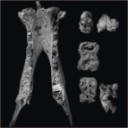
The discovery of new hippopotamid material from the late Miocene Baynunah Formation (Abu Dhabi, United Arab Emirates) has prompted the revision of the existing material of this as yet unnamed fossil taxon. The Baynunah hippopotamid appears to be distinct from all other contemporary and later species in having a relatively more elongate symphysis, a feature similar to the earlier (and more primitive) Kenyapotamus. Yet, the Baynunah hippopotamid presents a dentition typical of the Hippopotaminae. It is therefore a distinct species attributed to the later subfamily, described and named in this contribution. This species provides further evidence for a ca. 8 Ma evolutionary event (termed “Hippopotamine Event”) that initiated the spread and ecological significance of the Hippopotaminae into wet habitats across Africa and Eurasia. The morphological affinities of the new species from Abu Dhabi suggest that the Arabian Peninsula was not a dispersal route from Africa toward southern Asia for the Hippopotamidae at ca. 7.5 Ma to 6.5 Ma.
PV article infos
Published in Vol 41-1 (2018)
|
PDF
S.I. Data
|

|
Un gisement à mammifères dans la formation lacustre d'âge Miocène moyen du Collet Redon près de St-Cannat (Bouches-du-Rhone). Implications stratigaphiques
Published online: 10/04/1979
Keywords:
France; Neogene; Rodentia
https://doi.org/10.18563/pv.8.5.327-341
Abstract
The new fauna of Collet Redon (Bouches-du-Rhône, France) is dated by three rodents: Megacricetodon aff. bavaricus, Democricetodon affinis mutilus and Peridyromys cf. hamadryas. They correlate this locality with Oggenhof and Ohningen in Bavaria (Western Germany). As the radiometric age of Ohningen is estimated between 14 and 13 M.Y., these three localities are of Serravallian age. This datation brings a complete readjusment of the stratigraphy of the section of Collet Redon formerly described by Collot and Combaluzier. The marine deposits with underly the continental formation with the mammal fauna, are Burdigalian. The angular unconformity between the marine and the continental deposits gives evidence of an episode of emersion on the margin of a sedimentary basin, with deformation and erosion. Owing to the newly discovered fauna, this geodynamical event is clearly settled within the regional geographical and chronological context. Lacustrine and continental deposits of such an age were up to now unsuspected in this area.
PV article infos
Published in Vol. 08, Fasc. 5 (1979)
|
PDF
|

|
Essai de filiation des campagnols et des lemmings (Arvicolidae, Rodentia) en zone holartique d'après la morphologie dentaire.
Published online: 01/10/1980
Keywords:
Arvicolidae; Dental morphology; Paleogeography; phyletic relationships
https://doi.org/10.18563/pv.9.ext.375-382
Abstract
The Arvicolid evolution results in an increase of the dental structure complexity. The M3/ differenciation seems to characterise the tribe subdivisions, that of M/1 being variable from one to another lineage. The phyletic relationships of fossil lineages are discussed from a paleogeographic point of view.
PV article infos
Published in Vol. 9, Ext (1980)
|
PDF
|

|
Analysis of mammalian communities from the late Eocene and Oligocene of southern France
Published online: 15/12/1986
Keywords:
Late Eocene; Mammalian communities; Oligocene; Quercy; Southern France
https://doi.org/10.18563/pv.16.4.191-212
Abstract
Valverde's cenogram method is used to analyse mammalian communities from the late Eocene to late Oligocene of southern France, mainly from the "Phosphorites du Quercy". Cenogram analysis involves plotting the size of each component species in a fauna on a semilog diagram in rank order, permitting fossil faunas to be compared with Recent ones. The configurations of Recent communities serve as models for establishing the general environmental characteristics of fossil mammalian faunas. This method of analysis applied to faunal sequence can reveal major and sudden ecological perturbations. The paleobiogeographical event (i.e. the mammalian immigration wave) at the Eocene-Oligocene Boundary in western Europe, known as the «Grande Coupure", is here shown to represent a drastic and sudden ecological change: late Eocene tropical environments in Europe deteriorated rapidly turning to subdesert or desert environments al the beginning of the Oligoccne.
PV article infos
Published in Vol. 16, Fasc. 4 (1986)
|
PDF
|

|
Palaecarcharodon orientalis (Sinzow) (Neoselachii : Cretoxyrhinidae), from the Paleocene of maryland, USA.
Published online: 15/09/1989
Keywords:
Maryland; Palaeocarcharodon; Paleocene; Selachian; Systematics; U.S.A.
https://doi.org/10.18563/pv.19.1.1-6
Abstract
Recent collecting of fossil vertebrate remains from the lowermost member of the Aquia Formation (Paleocene), has enabled me to report here for the very fIrst time, the earliest occurrence for the teeth of Palaeocarcharodon in the fossil record of the New World.
This report represents only one species of neoselachian from this locality, the remaining fauna of which will subsequently be described.
PV article infos
Published in Vol. 19, Fasc. 1 (1989)
|
PDF
|

|
A primitive Emballonurid bat (Chiroptera, Mammalia) from the Earliest Eocene of England
Published online: 16/12/1996
Keywords:
bats; Early Eocene; Emballonuridae; Origins; PHYLOGENY
https://doi.org/10.18563/pv.25.2-4.287-300
Abstract
A new genus, Eppsillycteris, is erected for Adapisorex? allglicus COOPER, 1932, from the earliest Eocene Blackheath Beds of Abbey Wood, London, England. Various derived character states indicate that it belongs to the order Chiroptera (bats) rather than to the extinct "insectivore" family Adapisoricidae. Other derived character states are shared with fossil and modern members of the family Emballonuridae. Placement of the new genus in this family extends the record of the Emballonuridae back in time by about 10 million years. It is the earliest record of a modern bat family and one of the earliest bats. This implies that the differentiation of at least some modern bat families took place in the Palaeocene, where no authenticated records of bats yet exist. The primitive characters of the earliest bats make the family Nyctitheriidae an unlikely stem group for the order Chiroptera. A tentative plausible alternative exists in some unnamed upper molars from the Palaeocene of Walbeck, Germany. Wyollycteris chalix, described as a bat from the Late Palaeocene of Wyoming, U,S.A., fits better in the family Nyctitheriidae.
PV article infos
Published in Vol. 25, Fasc. 2-4 (1996)
|
PDF
|

|
First report of an Eocene reptile fauna from Florida, USA
Published online: 30/07/2001
Keywords:
Eocene; Fauna; Florida; Reptile; USA
https://doi.org/10.18563/pv.30.1-2.1-10
Abstract
Fossils of the Trionychidae, Bataguridae or Emydidae, Palaeophis and Crocodylia from Chattahoochee, NW Florida, USA, represent the first report of an Eocene reptile fauna from Florida.
PV article infos
Published in Vol. 30, Fasc. 1-2 (2001)
|
PDF
|

|
La palichnofaune de vertébrés tétrapodes du permien supérieur du Bassin de Lodève (Languedoc-France).
Published online: 15/09/2000
Keywords:
Footprints; France; Languedoc; Lodève basin; new ichnotypus; Saxonian; Upper Permian
https://doi.org/10.18563/pv.29.1.1-82
Abstract
Near "la Lieude", in the Lodève basin, more than a thousand of footprints are distributed in a twenty of trackways which amounts to 220 m length. They have been found on calcareous siltstone level in the B site named also "Réserve Naturelle Volontaire". This last is located in the Saxonian summit dated Upper Permian. "La Lieude" tracks are described by using statistical methods then they are compared with others from the world Permian. What allows to distinguish 4 following ichnotaxa: Lunaepes ollierorum nov.ichnosp., Merifontichnus thalerius nov. ichnogen. and nov. ichnosp., Planipes brachydactylus nov.ichnosp. and Brontopus circagiganteus nov. ichnosp. All these traces are attributed with possibility or probability to Therapsida or to Therosauria, except Brontopus circagiganteus nov. ichnosp. that could be due to Caseamorpha. All these animals whose sizes have been estimated between l and 5 m lived probably in a playa environment.The biological and sedimentological data from "la Lieude" footprints levels compared with informations provided by the tracks orientations, suggest the following scenario. Animals coming from the North have crossed a sandy channel bank with plants zones by directing to the South for the majority. Maybe, they were going to the lacustrine part of the playa, close to "la Lieude" footprints that they have just trampled on.
PV article infos
Published in Vol. 29, Fasc. 1 (2000)
|
PDF
|