Current issue


2025-12
48-2
<< prev. next >>

Print ISSN: 0031-0247
Online ISSN:
2274-0333
Frequency: biannual

Article Management

You must log in to submit or manage articles.

You do not have an account yet ? Sign up.

Most downloaded articles (last 90 days)


Page 10 of 19, showing 20 record(s) out of 365 total

L'occlusion dentaire chez Peradectes, Amphiperatherium et Peratherium, Marsupiaux du tertiaire d'Europe.
Jean-Yves Crochet
Published online: 01/10/1980

Keywords: Didelphidae; Eocene; Mastication; Oligocene; Wear facets

https://doi.org/10.18563/pv.9.ext.79-89

  Abstract

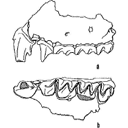
    The general principles guiding the study of wear facets which develop during mastication in mammals possessing tribosphenic molars are named. The application of this method of study to the molars of European Tertiary Didelphidae shows that the lineage of this family as represented by the species Peratherium cuvieri (Upper Eocene), P. elegans (Lower-middle Oligocene) and P. antiquum (Upper Oligocene) has propessively evolved toward a more carnivorous diet. 


  PV article infos

Published in Vol. 9, Ext (1980)

PDF
Les crocodiliens paléogenes du Tilemsi (Mali): un aperçu systématique
Eric Buffetaut Logo
Published online: 01/10/1980

Keywords: Crocodilians; Dyrosoridae; Eocene; Mali; Palaeocene

https://doi.org/10.18563/pv.9.ext.15-35

  Abstract

    Abundant crocodilian fossil remains have been collected, mainly by R. Lavocat. from several levels of the
    Palaeogene of the Tilemsi valley (eastern Mali). Several dyrosaurids occur in the Palaeocene (Montian ?) : Phosphatosaurus sp., Hyposaurus bequaerti (Dollo). H. wilsoni (Swinton). H. nopesai (Swinton), Rhabdognathus rarus Swinton, R. compressus n. sp. ln the lower Eocene has been found a dyrosaurid which cannot be accurutely determined.In the middle Eocene were found a dyrosaurid, Tilemsisuchus lavocati n. g., n. sp., and an indeterminate eusuchian. 


  PV article infos

Published in Vol. 9, Ext (1980)

PDF
The Quaternary avifauna of Crete, Greece.
Peter D. Weesie
Published online: 01/09/1988

Keywords: Avifauna; Crete; Quaternary; Systematics

  Abstract

    Pleistocene bird fossils have been studied from nine localities on Crete. Part of this material was described earlier by the author (Weesie, 1982) and will not be treated here in extenso, the results will be incorporated. More than one third of the over 10,000 fossil bird bones available could be identified ; they were found to represent at least 65 bird species. The following species of the Pleistocene Cretan avifauna are new to the fauna of Crete : Branta ruficollis, Haliaeetus albicilla, Gyps melitensis, Aquila chrysaetos simurgh n. ssp., Ketupa zeylomensis, Aegolius funereus, Dendrocopos leucotos, Zoothera dauma, Turdus iliacus and Pyrrhula pyrrhula. The Pleistocene Cretan avifauna differs less from comparable mainland avifaunas than (fossil) avifaunas from oceanic islands do. Still, the Pleistocene Cretan avifauna has two qualities that are characteristic of island avifaunas : the almost complete absence of a group of birds (the Galliformes) and the presence of two endemic (sub)species : the giant eagle Aquila chrysaetos simurgh n. ssp. and the long-legged owl Athene cretensis (Weesie, 1982). The new subspecies is described in the present study.
    These endemic birds of prey were found in association with their supposedly principal prey species (now extinct as well) : endemic mice for the owl and endemic deer for the eagle. Endemic mammals have been found in association with endemic birds of prey on many islands, not only in the Mediterranean. There is evidence that the size of endemic birds of prey becomes optimally adapted to their feeding on certain endemic mammals, especially rodents. Another characteristic of the Pleistocene Cretan avifauna is the great number of species of birds of prey. This appears to be a common characteristic of fossil avifaunas from caves on Mediterranean islands as well as from caves on the European mainland. However, we think that ecological conditions on Pleistocene Crete (especially the abundant presence of mice) helped to account for the high representation of birds of prey. Furthemore, the fossil avifauna enables us to draw some conclusions about the climate and vegetation on Pleistocene Crete : it is concluded that the climate was cooler than today and that Crete was largely covered with forests. Finally, the reasons for the extinction or disappearance from Crete of some bird species of the Pleistocene Cretan avifauna are discussed. 


  PV article infos

Published in Vol. 18, Fasc. 1 (1988)

PDF
Octodontid-like Echimyidae (Rodentia) : an upper Miocene episode in the radiation of the family
Diego H. Verzi Logo, Maria G. Vucetich Logo and Claudia I. Montalvo Logo
Published online: 20/05/1994

Keywords: Argentina; Echimyidae; Miocene; New taxa; Rodentia; South America

  Abstract

    Reigechimys octodontiformis gen. et sp. novo and R. plesiodon sp. novo are described. They represent the frrst record of the family Echimyidae for the Cerro Azul Formation (Huayquerian Age, Late Upper Miocene) at La Pampa Province, central Argentina. Both species have hypsodont cheek teeth with an eight-shaped occlusal design. This dental morphology represents a noticeable case of convergence to octodontids and indicates that these echimyids inhabited open environments. 


  PV article infos

Published in Vol. 23, Fasc. 1-4 (1994)

PDF
Mode de vie et affinités de Paschatherium (Condylarthra, Hyopsopontidae) d'après ses os du tarse
Marc Godinot Logo, Thierry Smith Logo and Richard Smith
Published online: 16/12/1996

Keywords: Astragalus; Calcaneum; Condylarthra; Eocene; Functional morphology; Paschatherium; PHYLOGENY

  Abstract

    Tarsals that can be confidently attributed to Paschatheríum dolloi from Dormaal (Belgium) are described. The astragalus is short; its broad neck is set at an angle of 30 degrees to the trochlea. The trochlea is pulley-shaped and proximally extended. There is no astragalar foramen. The medial tibial facet extends distally in a cup deeply excavated in the neck and buttressed. The sustentacular facet extends toward the navicular facet but is not fully confluent with it. The calcaneum bears a proximo-distally extended proximal facet for the astragalus. A relatively large peroneal tubercle projects from the body, and is situated distally. Functionally, the trochlea indicates extensive flexion-extension movements of the foot. Calcaneo-astragalar facets indicate sliding and rotation between the two tarsals. The inclination of the navicular facet suggests frequent foot inversion. The peroneal tubercle reflects good muscular capacities for foot rotation. Overall morphology is interpreted as a scansorial adaptation similar to that of sciurids.Comparisons are made with the tarsals of Macrocranion vandebroeki from Dormaal and Hyopsodus paulus from the Bridgerian of Wyoming. Some similarities between the astragali of Paschatherium and Macrocraníon (trochlea) are interpreted as convergences for rapid locomotion. However absence of mobility at the lower ankle and midtarsal joints in M. vandebroekzi suggests that this species was cursorial, as is known for M. tenerum from Messel. Similarities in the calcanea of Paschatherium and Hyopsodus are probably the result of close phylogenetic relations, and confirm the placement of Paschatherium in the hyopsodontids. The differences in the calcanea of Paschatherium and Macrocranion underline that Paschatherium is distinct from erinaceomorph insectivores. The differences in astragalar morphology between Paschatherium and Hyopsodus show that a marked adaptive divergence separates the two genera. We speculate about the common occurrence of a deep tibial cup (“cotylar fossa”) and a pulley-shaped trochlea in Paschatherium and hyracoids, suggesting that an adaptive scenario similar to that having led to Paschatherium (scansoriality) might explain the acquisition of the peculiar hyracoid tarsal characters; such a scenario contradicts the concept of Pantomesaxonia. Other peculiar characters of Hyopsodus suggest that hyopsodontids might be given more consideration in the search for hyracoid (and tethythere) origins. 


  PV article infos

Published in Vol. 25, Fasc. 2-4 (1996)

PDF
Les poissons crétacés et tertiaires du bassin des Iullemmeden (République du Niger)
Henri Cappetta Logo
Published online: 15/09/1972

Keywords: Actinopterygians; Cenozoic; Cretaceous; Dipnoans; Selachians

https://doi.org/10.18563/pv.5.5.179-251

  Abstract

    The present work is devoted to the study of the Cretaceous and Tertiary fishes (teeth of Selachians, Actinopterygians and Dipnoans) collected during a recent expedition in Niger. The Maestrichtian localities have yielded a new genus and a new subspecies of Selachian: Igdabatis sigmodon nov. gen., nov. sp. and Lamna biauriculata nigeriana nov. subsp. The locality of Sessao, which has been attributed to the Thanetian by means of the study of the fish, has furnished by screen-washing an interesting fauna wherein six new species are described: Raja Iouisi, Dasyatis sessaoensis, D. sudrei, D. russelli, Hypolophites thaleri and Ceratodus casieri. Comparison of these faunas with contemporary faunas of Africa has brought out a certain endemism in the Iullemmeden Basin during the late Cretaceous and the early Tertiary. 


  PV article infos

Published in Vol. 05, Fasc. 5 (1972)

PDF
Révision des Artiodactyles de l'Eocène moyen de Lissieu (Rhône)
Jean Sudre
Published online: 15/05/1972

Keywords: Artiodactyles; Dichodon; France

https://doi.org/10.18563/pv.5.4.111-156

  Abstract

    The object of this work is the study of the artiodactyls of the karstic locality of Lissieu near Lyon. Among the sixteen species counted, five (Hyperdichobune nobilis, Hyperdichobune sp., Haplabunodon mulleri, Tapirulus depereti and Pseudamphimeryx schlosseri) are cited for the first time in this fauna. The description of part of the anterior dentition of «Dichobune» langi permits the referal of this species to the genus Hyperdichobune. The new selenodont species Dichodon lugdunensis  described in this work belongs, with its ancestor Dichodon simplex, to a lineage distinct from that of Dichodan cartieri and Dichodon ruetimeyeri. Finally, the taxonomic reality of the Lissieu species, Lophiobunodon rhodanicum Deperet, is justified. All the other species have been compared with those of Egerkingen. Even though with most of them no difference in age can be shown between the two deposits, some however indicate clearly by their degree of evolution that Lissieu is slightly more recent than Egerkingen. ln the history of Eocene mammals, the Lissieu fauna, because of its homogeneity, can be considered as a sure reference fauna of the Auversian period. 


  PV article infos

Published in Vol. 05, Fasc. 4 (1972)

PDF
Présence de Palaeobatrachidae (Anura) dans des gisements tertiaires Français caractérisation, distribution et affinités de la famille
Colette Vergnaud-Grazzini and Robert Hoffstetter
Published online: 15/05/1972

Keywords: Anura; Palaeogeography; Systematics

https://doi.org/10.18563/pv.5.4.157-177

  Abstract

    The Palaeobatrachidae until now have not been reported from France. The present note makes known the discovery of very significant remains in three Tertiary localities of France: Cernay (late Paleocene), Laugnac (late Aquitanian) and Sansan (middle Helvetian). The osteologic characters, as well as the geographic and stratigraphic distribution of the family are re-stated with added details. The Palaeobatrachidae are a European family known from the late Jurassic of Catalonia (publication in course by J. Seiffert) to the Plio-Pleistocene (pre-Mindel) of Poland and Rumania. By their way of life and certain osteologic characters they are similar to the Pipidae, but they are distinguished by profound differences. It would be rash to include them in the Pipoidea or even in the Aglossa. They are apparently an independant group, essentially holarctic, which held in Europe a role equivalent to that played by the Pipidae south of Tethys. 


  PV article infos

Published in Vol. 05, Fasc. 4 (1972)

PDF
Nouveaux gisements à rongeurs dans les molasses oligo-miocènes de la région toulousaine
Francis Duranthon Logo
Published online: 11/02/1993

Keywords: Cricetidae; Eomyidae; GIiridae; Miocene; Oligocene; Rodents; Sciuridae; Southern France

  Abstract

    The fauna from three new rodent localities (Castelmaurou, Grépiac-carrière et Grépiac-rive gauche) from Oligo-Miocene molasses of the Toulouse area is described. The one from Colomiers is completed. 11 species belonging to 4 families (Cricetidae, Eomyidae, Gliridae, Sciuridae) are present. The Miocene localities of Grépiac-carrière and Colomiers are correlated with Balizac, La Brète, Lambert and Lespignan. Grépiac-rive gauche is just a little older than these sites. Castelmaurou is somewhat younger than La Milloque and belongs to Oligocene. 


  PV article infos

Published in Vol. 22, Fasc. 2-3 (1993)

PDF
Crivadiatherium iliescui n. sp., nouvel Embrithopode (Mammalia) dans le Paléogène ancien de la dépression de Hateg (Roumanie).
Constin Radulesco and Jean Sudre
Published online: 30/12/1985

Keywords: Embrithopods; Late Eocene; Paleobiogeography; Romania

  Abstract

    The investigations undertaken at Crivadia (Hateg Depression, Hunedoara District, Romania), the type locality of Crivadiatherium mackennai RADULESCO el al. (Radulesco, Iliesco et lliesco, 1976), led to the discovery of remains of a new Embrithopod. Close to the above mentioned species, but larger in size, this animal is here described as a new species of Crivadiatherium, C. iliescui. ln addition, the comparison made between the forms indicated above and Palaeaamasía kansui OZANSOY from the Eocene deposits of Anatolia (Ozansoy, 1966; Sen et Heintz, 1979) showed that the latter species included a heterogeneous material; this permitted us to distinguish the form in the Anatolian locality Ciçekdag-Arabin Kôyü under the name Palaeoamasia sp. The geographical distribution and diversity of the Embrithopod species under discussion (Balkan, Anatolia) support the idea of an eurasiatic origin of this group and seem to suggest the existence during the Eocene of a particular faunal province in south-eastern Europe. 


  PV article infos

Published in Vol. 15, Fasc. 3 (1985)

PDF
Contributions à l'étude des micromammifères du gisement Miocène supérieur de Montredon (Hérault). 1- Le gisement
Jean-Pierre Aguilar and Jean-Yves Crochet
Published online: 30/06/1982

Keywords: Hérault; Late Miocene; Micromammals; Montredon

https://doi.org/10.18563/pv.12.3.75-79

  Abstract

    La localité fossilifère du Puech de Montredon, désignée plus communément sous le nom de Montredon, est située sur la commune de Montouliers (Hérault) à quelques 300 mètres de la limite avec le département de l'Aude. Elle a été découverte en 1845 par Narbonne, Directeur des Mines de La Caunette, et de très nombreux restes de vertébrés continentaux y ont été extraits. La plus ancienne mention de ce gisement dans la littérature semble être celle de Lartet (1859) qui signale que "M. Jourdan, de Lyon, a constaté à Montredon, près de Bize (Aude), l'association des restes de Dinotherium avec l'Hipparion". 


  PV article infos

Published in Vol. 12, Fasc. 3 (1982)

PDF
The terrestrial environnement and the origin of land vertebrates
Jean-Louis Hartenberger
Published online: 02/12/1980

Keywords: environments; Land vertebrates; Terrestrial

https://doi.org/10.18563/pv.11.1.17

  Abstract

    L'ouvrage rassemble vingt contributions présentées lors d”un colloque organisé par l'éditeur en avril 1979, à Newcastle upon Tyne. Ce sont différents aspects du problème de la << sortie des eaux ›> qui ont été abordés lors de cette réunion. Par son volume, la qualité des communications, l”abondance des illustrations, nul doute que ce livre est appelé à devenir un ouvrage de référence pour les paléontologistes qui s'intéressent de près ou de loin à ce problème : enseignants et cher cheurs y trouveront leur compte. ll est un peu regrettable toutefois qu'aucun tenant de <<l”école suédoise» n'ait eu l`occasion d`y présenter ses thèses.


  PV article infos

Published in Vol. 11, Fasc. 1 (1981)

PDF
Fossil snakes from the Palaeocene of São José de Itaboraí, Brazil Part III. Ungaliophiinae, Booids incertae sedis, and Caenophidia. Summary, update and discussion of the snake fauna from the locality
Jean-Claude Rage Logo
Published online: 16/12/2008

Keywords: booid-grade incertae sedis; Brazil; Caenophidia; New taxa; Palaeocene; Russellophiidae; Snakes; tropidophiids; Ungaliophiinae

https://doi.org/10.18563/pv.36.1-4.37-73

  Abstract

    Aside from Madtsoiidae, anilioids, and Boidae that were studied previously, the middle Palaeocene of ltaborai (BraziI) has produced Ungaliophiinae ("tropidophiids"), booid-grade snakes incertae sedis, and a possible Russellophiidae (Caenophidia) that are described in the present article. This article is the third and final report on the snakes from the locality. The Ungaliophiinae (Paraungaliophis pricei gen. et sp. nov.) are rare whereas the booid-grade snakes incertae sedis (ltaboraiophis depressus gen. et sp. nov., Paulacoutophis perplexus gen. et sp. nov.) are more frequent. A single vertebra is referred to the Russellophiidae (Caenophidia) with reservation. An update of the whole fauna of snakes from ltaborai is provided. Hechtophis austrinus that was tentatively referred to the erycine Boidae is now regarded as a Boidae incertae sedis. Most snakes from Itaborai are known only from the locality. Astonishingly, only the ailioids Coniophis cf. C. precedens gives possible evidence of interchanges between South and North America. The fauna of snakes from Itaborai, as well as the other Palaeocene faunas of snakes from South America are distinct from those of the Cretaceous and the Eocene of South America; they appear to be more different from the Cretaceous faunas than from those of the Eocene. The fauna from Itaborai is the richest and most diverse assemblage of snakes from the Palaeocene worldwide; it shares only a few taxa with other Palaeocene localities. 


  PV article infos

Published in Vol. 36, Fasc. 1-4 (2008)

PDF
La poche à phosphate de Ste-Néboule (Lot) et sa faune de vertebres du Ludien supérieur. 11- Créodontes
Brigitte Lange-Badré
Published online: 25/09/1978

Keywords: Creodonta; Eocene; Quercy Phosphorites

https://doi.org/10.18563/pv.8.2-4.295-299

  Abstract

    The teeth and the astragale of the Creodonta from Ste-Néboule (Lot) are referred to Hyaenodon brachyrhynchus. Isolated teeth fit morphologically the material from La Débruge (Middle Ludian). However, biometric analysis suggests an Upper Ludian age. 


  PV article infos

Published in Vol. 08, Fasc. 2-4 (1978)

PDF
Compléments sur les Chiroptères de l'Eocène moyen d'Europe. Les genres Palaeochiropteryx et Cecilionycteris.
Bernard Sigé and Donald E. Russell
Published online: 01/10/1980

Keywords: Chiroptera; Geiseltal; Messel; Middle Eocene

https://doi.org/10.18563/pv.9.ext.91-126

  Abstract

    New dental and skeletal material referable to Palaeochiropteryx tupaiodon from the Middle Eocene locality of
    Messel (G.F.R.) is studied, which provides additions to the previously gained knowledge of this european genus. Dental specimens from Geiseltal (G.D.R.), also of Middle Eocene age, allow us to analyze Cecilionycteria prisca. Some of these are separated to establish a new genus, Matthesia, and two new species, M. germanica and M. ? insolita


  PV article infos

Published in Vol. 9, Ext (1980)

PDF
Artiodactyla aus den Eozänen Braunkohlen des Geiseltales bei Halle (DDR)
Jorg Erfurt and Hartmut Haubold
Published online: 04/12/1989

Keywords: Artiodactyles; Eocene; Europe; Paleoecology; Stratigraphy; taxonomy

  Abstract

    The present study of Artiodactyla from the Middle Eocene of the Geiseltal lignite beds concems systematics, biostratigraphy, and palaeoecology on the basis of 174 specimens: isolated remains to more complete skeletons. Instead of the formerly known five species of two families are now recognized 14 species of the Diacodexeidae, Dichobunidae, Cebochoeridae, and Haplobunodontidae. New species are Aumelasia maniai, Anthracobunodon neumarkensis, Masillabune franzeni. Four species of the Geiseltalfauna are definitely known from elswere, and five species are closely related to those from other European localities. Evidently the faunal situation of artiodactyls during the Middle Eocene of Europe was largely uniform. The distribution of artiodactyls within the sequence of the Geiseltal strata corroborates the biostratigraphical concept of the land mammal age Geiseltalian (Franzen & Haubold l986b) as well as the mammalian reference levels MP 11-13 (Franzen 1987). Reconstructions of the skulls and skeletons allow conclusions on the functional morphology and palaeoecology of the artiodactyls of the European Middle Eocene 


  PV article infos

Published in Vol. 19, Fasc. 3 (1989)

PDF
Les Tayassuidés des phosphorites du Quercy
Léonard Ginsburg
Published online: 15/11/1974

Keywords: Quercy Phosphorites; Tayassuidae

https://doi.org/10.18563/pv.6.1-2.55-85

  Abstract

    Revision of the Tayassuidae from the old collections of the Quercy leads to interesting facts about taxonomic and phylogenetic problems. It could not have been well done without constant comparison with contemporaneous Tayassuidae from stratified series, as well as with European Miocene Tayassuidae and Hyotheriinae. The result is that only three species are present in the Phosphorites of Quercy: Doliochoerus quercyi FiLHOL (represented by two sub-species: the older, D. quercyi quercyi and the more recent, D. quercyi aquensis), Palaeochoerus gergorianus CROIZET et BLAINVILLE and Palaeochoerus purillus nov. sp. The two former species disappeared with Stampian time, while the third is the direct ancestor of the Aquitanian Palaeochoerus typus POMEL, which became extinct before the beginning of Burdigalian.

    The comparison with Hyotheriinae brought to light new criteria for determinations, based on the study of lower premolars. These observations are condensed in a table of keys for determinations.

    As a result of these studies, it came to light that the Suoidea of the Oligo-Miocene of Europe have never given rise to, except in rare cases, very long lineages. The different forms of pigs are replaced constantly in Europe by the simple game of extinctions and migrations. The reason of that discontinuity is considered here. 


  PV article infos

Published in Vol. 06, Fasc. 1-2 (1974)

PDF
An Australian Miocene Brachipposideros (Mammalia, Chiroptera) related to Miocene representatives from France
Bernard Sigé, Suzanne J. Hand Logo and Michael Archer Logo
Published online: 15/12/1982

Keywords: Australia; bats; Chiroptera; Miocene

https://doi.org/10.18563/pv.12.5.149-172

  Abstract

    A new middle Miocene hipposiderid bat is described from a limestone deposit on Riversleigh Station in north-western Queensland. Hipposideros (Brachipposideros) nooraleebus n. sp. is the first record of this subgenus from anywhere in the world outside of France. The palaeoecological setting of the fossil bats appears to have been a relatively quiet, sunny lime-enriched tropical pool that contained tortoises, crocodiles and fish. It is possible that the bats were washed into the pool from an adjacent cave.
    The Riversleigh bat most closely resembles the French Burdigalian (early middle Miocene) bat H. (B.) aguilari. It is also possible that it may have been closely related to the original Australian hipposiderid stock that ultimately gave rise to the endemic monotÿpic Rhinonycteris aurantius. The disjunct distribution of species of H. (Brachipposideros) suggests that representatives of this subgenus will be found in at least tropical southern Asia. 


  PV article infos

Published in Vol. 12, Fasc. 5 (1982)

PDF
Les mammifères de Rians (Eocène inférieur, Provence)
Marc Godinot Logo
Published online: 01/02/1981

Keywords: Eocene; Mammals; Provence; Rians

https://doi.org/10.18563/pv.10.2.43-126

  Abstract

    The fossil mammals discovered in the quarry of Rians (Sparnacian, Provence) are described. Among these forms, Hyracotherium is interesting because of the little molarization of the lower premolars and its small size, and Diacodexis by its small size and very primitive astragalus ; they may be the most primitive representatives of their respective orders. Also, Proviverra eisenmanni n. sp. is the smallest and most primitive hyaenodontid yet described. Hyopsodus itinerans is the first species of this genus described France. Among other rare fossils is a new species of bat, a small palaeoryctid, and other forms not yet identified. Marsupials are varied. Several new species are present among the rodents. The fauna is well-balanced and rich in small hyopsodontid condylarths. It is stratigraphically situated at the
    Dormaal reference-level, at the base of the early Eocene, and is considered equivalent to the late Clarkforkian of North America. The hypothesis is presented that new forms appearing at the beginning of the Wasatchian in North America migrated, in fact, at that time from Europe.


  PV article infos

Published in Vol. 10, Fasc. 2 (1981)

PDF
Les mammifères Montiens de Hainin (Paléocène moyen de Belgique) Part1: Multituberculés.
Monique Vianey-Liaud Logo
Published online: 01/11/1979

Keywords: Belgium; Hainin; Mammals; multituberculates; Paleocene

https://doi.org/10.18563/pv.9.4.117-131

  Abstract

    The Montian locality of Hainin (Hainaut, Belgium) yielded about twenty teeth of Multituberculates. They are very peculiar forms, showing no affinities, at the generic level, with those hitherto known from North America, Asia and Europe. They are referred to the new taxa Boffius splendidus nov. gen., nov. sp., Hainina belgica nov. gen., nov. sp., and H. godfriauxi nov. gen., nov. sp. They expose some common features, such as the advanced type of first upper molar. possessing at least three complete rows of cusps. Because of this, and also of the upper premolar reduction, Boffius splendidus appears as the most specialized form within the Ptilodontoidea suborder.
    Several other characters of Hainina seem to be less advanced, such as the great number of upper premolars and the simple cusp-formula of the first lower molar.
    Till now, only H. godfriauxi has been recovered within the Thanetian fauna from Cemay-les-Reims, where it is very poorly documented. 


  PV article infos

Published in Vol. 09, Fasc. 4 (1979)

PDF

Page 10 of 19, showing 20 record(s) out of 365 total